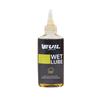
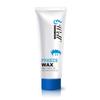
Fluid Wax emulsion is a revolutionary lubricant designed for maintaining and lubricating bicycle chains. Fluid Wax is an alternative to traditional wax lubricants, offering many advantages and innovative solutions.
This product description will explain why Fluid Wax is so unique and what benefits can be derived from using it.
There are countless wax combinations that can theoretically be good lubricants for bicycle chains. A wax lubricant is commonly understood as wax melted to a temperature of 60-95 degrees Celsius, in which the chain is dipped, which is then coated with a water-based wax.
This type of waxing is called immersion waxing.
Since 2018, so-called droplet waxes, which are wax-based droplet lubricants, have been appearing on the market. The development of waxy droplet lubricants has led to the lubrication parameters of immersion wax and droplet wax being virtually identical, while still being easy to apply.
Fluid Wax emulsion is designed to lubricate like wax while providing the benefits and ease of application of oil droplets.
Fluid Wax is an emulsion composed of several types of waxes, including microcrystalline wax, corrosion inhibitors, an emulsifier that thickens the liquid wax upon contact with air, and nanoparticles of white solid lubricants.
Other wax emulsions from this manufacturer also contain Teflon (PTFE) nanoparticles under the name HardWax, molybdenum disulfide nanoparticles under the name MolyWax, and a wax emulsion with tungsten disulfide WS2.
• Fluid Wax is a blend of various types of waxes, lanolin, jojoba oil, candelilla wax, earth wax and a number of synthetic waxes, which allows it to be adapted to various lubrication needs.
• Wax products for lubricating a bicycle chain are designed to protect the links from oxidation, while creating a protective barrier against dirt and sand.
• Lubrication of a bicycle chain with liquid wax is a traditional way of maintaining bicycle drive components.
• Fluid Wax can be used at temperatures from 0°C to 35°C, which makes it suitable for various weather conditions.
• Once Fluid Wax hardens, it becomes soft and flexible, which is beneficial for the efficiency and durability of your bike's drivetrain.
• The Fluid Wax emulsion has thixotropic properties, which makes the application process easier and ensures even lubrication.
1. Improved lubricity: Fluid Wax improves chain lubricity, which translates into smoother movement and reduced wear on drive components.
3. Weather resistance: Fluid Wax works in various weather conditions, including rain and humidity, providing long-lasting lubrication.
4. Self-cleaning: Dirt particles combine with the wax and fall off the chain, keeping it clean.
5. Noise Reduction: Lubricating with Fluid Wax can reduce drivetrain noise, which is especially important when cycling.
6. Ease of Application: Fluid Wax is easy to apply, and the lubricant can be applied to the chain while riding.
7. Waterproof and Corrosion Protection: Fluid Wax creates a waterproof barrier and protects the chain from corrosion.
Fluid Wax is suitable for a variety of bike types, including MTB, triathlon, gravel, racing and e-bikes, operating in both wet and dry conditions. It's perfect for riding in all weather conditions, providing optimal protection and lubrication for your drivetrain.
To remove Fluid Wax from your bike chain, you can soak it in hot water or use special chemicals. Once the wax is removed, you can reapply it to a clean chain.
In summary, Fluid Wax wax emulsion is an innovative product that combines the advantages of wax and droplet lubricants, ensuring protection and excellent lubrication of the bicycle chain. Thanks to its unique properties, Fluid Wax can improve the efficiency and durability of the drivetrain and ensure a comfortable ride in various conditions.
Basic product data Fluid Wax
Standard | Content | Unit | Result
CTM0176 | Color | | white
DIN 51 757 | Density at 20 ° C | g / ml | 0.82
DIN 51 562 | Wax viscosity (mixed at 0 ° C) | cSt | 220
DIN 51 562 | Wax viscosity (mixed at 35° C) | cSt | 10
Recommended application temperature range | ° C | 10 to 35
Temperature at which hardened wax melts | ° C | 60
Temperature of water used to wash off hardened wax | ° C | 70
DIN 51 350 pt.4 | Welding load | N | 1200
DIN 51 350 pt.5 | Load capacity mm | mm | 0.7
Flash point, ° C -> 200 | ° C | > -10
Auto-ignition temperature | ° C | approx. 300
Full drying time | hours | 4-8
Apply Fluid Wax to the chain links by turning the cranks, changing sprockets and leave to dry. Repeat this process for the first application. When the temperature is below 10 degrees, warm the liquid wax, apply it and leave to dry in a heated place.
Before re-applying Fluid Wax, it is not necessary to clean the chain very thoroughly, just wash off the old wax with hot water and dry it. Run the chain through a dry cloth, then apply a thin coat of new wax emulsion.
Do not apply oil-based lubricants to a waxed chain – the wax and oil will form a paste that will attract and retain dirt, significantly increasing friction and drivetrain wear.
Composition: several types of waxes including microcrystalline wax, inhibitors e.g. corrosion, emulsifier thickening liquid wax upon contact with air, nanoparticles of white solid lubricants
First application method: For the first use, the chain should be completely clean (degreased) and dry.


 Товар из Польши


 Возврат по недоставке