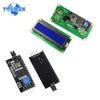
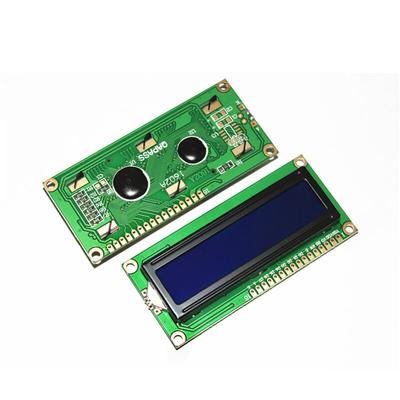
LCD1602/2004 LCD screen adapter board IIC/I2C/interface to send function library compatible for Arduino
Product parameters:
1. Supply voltage: +5V
2. Support I2C protocol
3. With backlight, and contrast adjustment potentiometer
4.4 line output is simpler
1602 uses a standard 16-pin interface, of which:
1 pin: VSS is the ground power
2 feet: VDD connects to 5V positive power supply
3 feet: V0 is the contrast adjustment terminal of the liquid crystal display. The contrast is the weakest when connected to the positive power supply, and the contrast is the highest when the power supply is grounded. When the contrast is too high, it will produce "ghosting". When using, you can adjust the contrast through a 10K potentiometer
Pin 4: RS is the register selection, the data register is selected at high level, and the instruction register is selected at low level.
Pin 5: R/W is the read and write signal line, read operation at high level, and write operation at low level. When RS and RW are both low level, the command or display address can be written. When RS is low level and RW is high level, the busy signal can be read. When RS is high level and RW is low level, data can be written.
Pin 6: The E end is the enable end. When the E end changes from high level to low level, the LCD module executes the command.
7~14 feet: D0~D7 are 8-bit bidirectional data lines.
15 feet: backlight power positive
16 feet: negative pole of backlight power supply
1602 The character generation memory (CGROM) inside the liquid crystal module has stored 160 different dot matrix character patterns, as shown in Table 1, these characters include: Arabic numerals, upper and lower case of English letters, commonly used symbols, and Japanese kana, etc. , Each character has a fixed code. For example, the code for the uppercase English letter "A" is 01000001B (41H). When displaying, the module displays the dot matrix characters in the address 41H, and we can see the letter "A" "