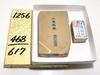
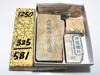
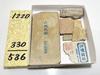
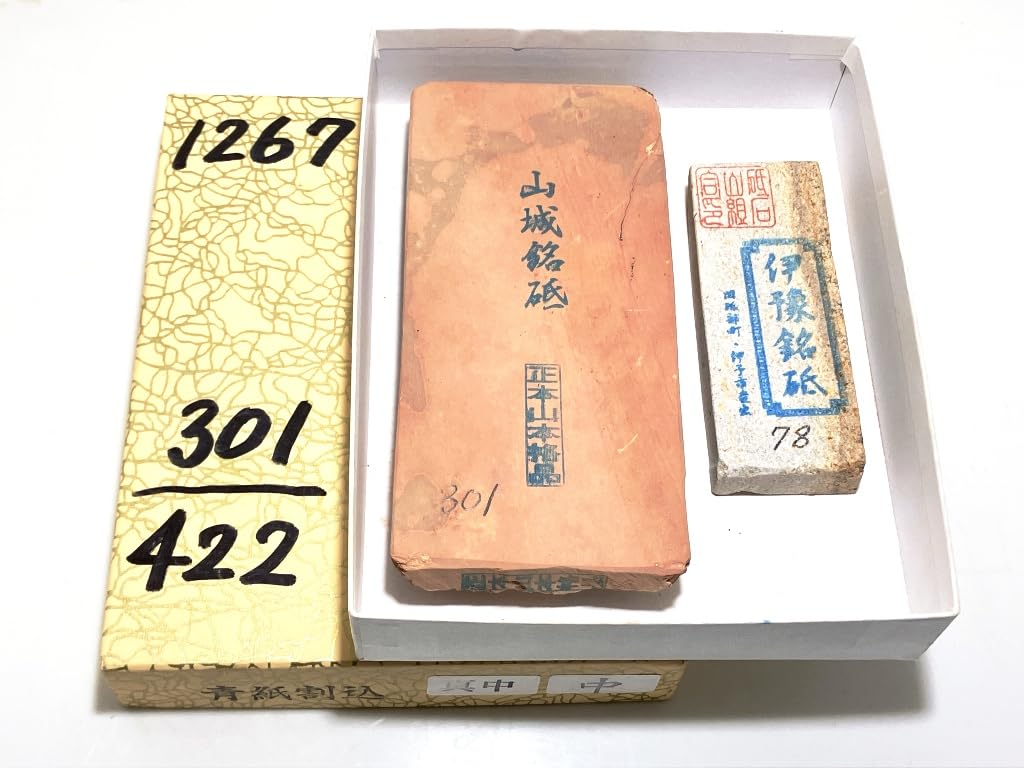
Contains one finished whetstone weighing 301g. The size is indicated by the outer dimensions of the box. The total weight of one whetstone, including the outer box and the rough forging stone, is 422g. These are medium to high-grade whetstones from Iyo Province and Shohonzan Yamashiro Province, with the miner's name handwritten on them as a measure against misrepresentation of origin and counterfeit products. The forging scraps as shown in the image are placed in the margin and sealed. The rough stone scraps do not have names written on them, so please judge their physical properties by touching them yourself. Suitable for avant-garde individuals with competitive and training elements.
Neutral and rust-resistant, Iyo stone from Karakawa Murayama, dating back to the feudal era, revived after half a century! ! https://bit.ly/IyoMIkantsubu 10 Higonokami knives. Box outer dimensions (approx.): 12 x 15 x 2.8~5.4 cm. Thickness varies. (Actually overflows and bulges) Total weight including box: approx. 422g. Zero gacha element, which many customers have requested. You will receive the stone exactly as pictured.
Please polish any rough edges to make them flat. If it's unstable, place a damp cloth underneath or use silicone adhesive on a non-deforming stand. Mining is done with heavy machinery, and cutting is done with diamond tombstone cutters. We are not involved with whetstones bearing the "Iyo Meito" name, as they are imitations and unauthorized branded products. Since around 2007, only whetstones bearing the "Iyo Meito" name have been made by Sazare Meito. To distinguish them, the names on all whetstones except the small pieces are handwritten. We cannot answer inquiries about "Iyo Meito" whetstones that have been processed and manufactured by other companies.
Siliceous slate from Umegahata, Ukyo-ku, Kyoto City, Yamashiro Province. Grit size #6,000 to 24,000. Harder stones require more practice, but the probability of achieving a finer finish increases. Due to the rounded bottom and continuous grooves, it maintains its sharpness for about 70% of its lifespan, and with artificial stone grit ratios, it is less likely to produce a dull, mirror-like finish, making it easier to bring out contrasts derived from the weld lines, material, and carbon content differences.
The darker the rock, the harder and finer the stone tends to be. Since hardness reduces the sharpness, sharpening should be done by applying a nagura (a type of stone for sharpening) as needed, depending on the purpose and skill level.
How can we continue to create "even better grinding wheels"?
〇Ashamed of the current situation where people say, "Playing with a toss wheel is like gambling or a matter of compatibility," let's think and consider every day, "Let's make a better toss wheel," and let's ask everyone without being embarrassed.
Even if they are thin, slender, or compact, let's not be careless or cut corners, and let's carefully ensure they fulfill their true purpose as tools. Because they hold the power to cultivate a repair spirit that leads to a better sharpening life for everyone.
Let's show our gratitude to our predecessors at Toyama by keeping it clean and bright. It is because of the accumulation of work that has continued for so long that we can enjoy the convenience and abundance we take for granted today. Let's cherish and protect what we are grateful for, both visible and invisible, and never forget it.
Let's properly convey the intangible inner assets of the whetstone craftsman and continue making "even better whetstones" so that everyone can continue to enjoy a happy sharpening life.
This product is a jointly sold product of a Kyoto Prefecture-approved business cooperative related to mining, established by several whetstone landowners and whetstone craftsmen with business areas in Narutaki and Umegahata, Ukyo Ward, Kyoto City, who came together with this vision.
In order to ensure local production and manufacturing within the project area, we will centralize joint erosion control management, mining, ore sorting, and manufacturing within our cooperative. This will allow us to provide more accurate and detailed information about the origin of the ore, and also contribute to quality control.
The geological information on mineral deposits, construction techniques, and stone forging methods, which have been passed down continuously from the Honma family of the Jingoji territory since the late Heian period and from the Yamamoto family since the early Edo period, are currently based on oral tradition and reliance on experience in apprenticeship relationships. To address these concerns for the future, we advocate for joint ownership and supplementation, hoping to create an environment for training future generations and ensure the continuation of this traditional industry for generations to come.
While geographical information is certainly essential for mining, we hope that by burning with passion every day to "make even better grinding wheels," and by thinking together, listening to everyone, and steadily putting in the effort, better successors will emerge, and "even better grinding wheels" will continue to be produced.


 Товар из Японии


 Возврат по недоставке