What does it take to continue creating ‘better whetstones’?
〇It’s said that ‘whetstones are a matter of compatibility,’ but let’s not be ashamed of the present. Let’s think and consider every day, ‘Let’s make better whetstones,’ and bravely ask everyone around us.
〇Even if they are thin, narrow, or compact, don't let your guard down, don't cut corners, and strive to perform their function as tools with care. They possess the power to cultivate a spirit of mending that will lead to even better sharpening lives for everyone.
〇Let’s care for them cleanly and brightly, expressing gratitude to the pioneers of [Togiyama]. Because there has been a long history of accumulation, we can enjoy the convenience and richness of today. Let’s cherish and protect both what we can see and what we cannot see, and never forget it.
〇Let’s properly pass on the intangible assets of the whetstone craftsman and continue to create ‘better whetstones’ so that everyone’s happy sharpening lives will continue.
This is a collaborative sales product of a Kyoto Prefecture-approved mining business cooperative established by multiple whetstone craft businesses and landowners of [Togiyama] located in Nagataki and Ume-ga-Hata, Kyoto City.
To produce locally within the business area, our cooperative centralizes joint forestry management, mining, ore selection, and manufacturing to provide more reliable evidence of the origin and contribute to quality control.
Since the late Heian period, the Honma family of the Jingoji Temple domain, and since the early Edo period, the Yamamoto family have passed down information about the ore deposits, construction techniques, and stone forging skills. To avoid the anxiety of relying on oral tradition and apprenticeship, we promote joint ownership and mutual supplementation to create an environment for nurturing the next generation and connecting to a long-lasting traditional industry.
Geographic information is certainly essential for mining, but we burn with the desire every day to ‘make better whetstones,’ and by thinking together, listening to everyone, and steadily accumulating effort, we hope that even better successors will be born and ‘better whetstones’ will continue to be created.
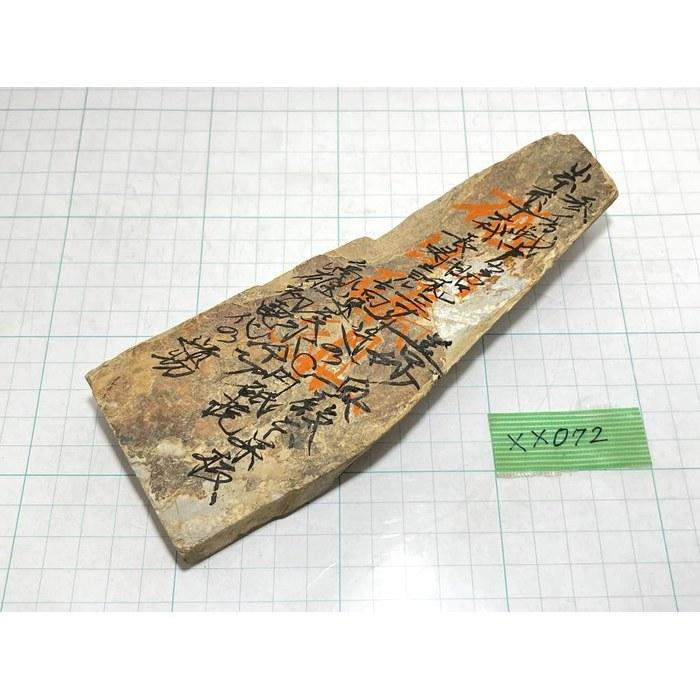
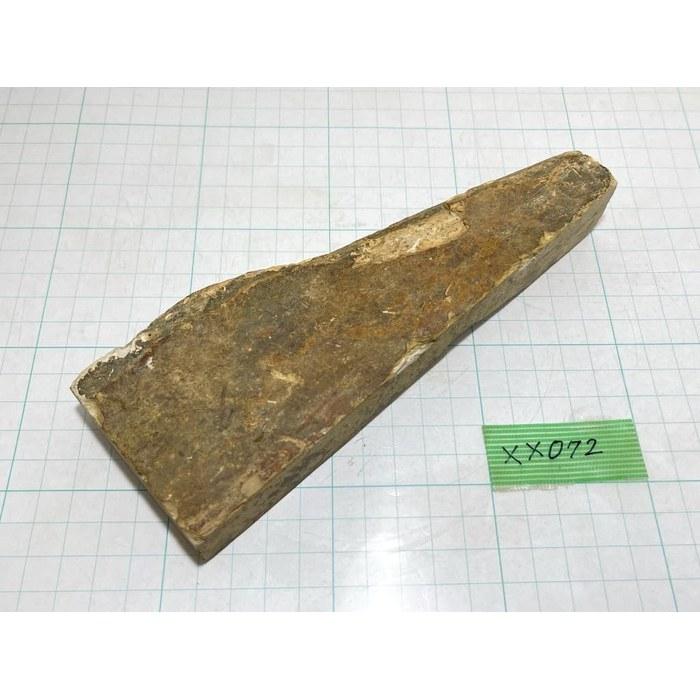
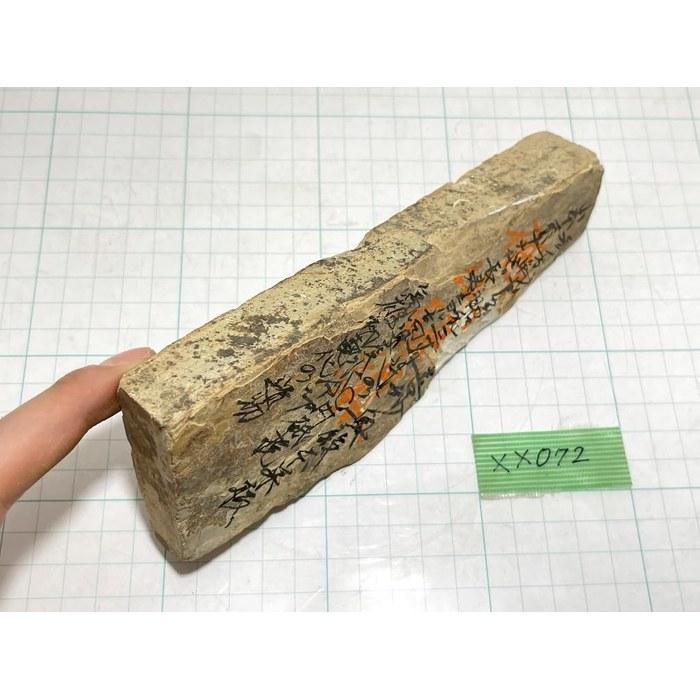
・Capable of producing a typical, deep-white, honeycomb pattern. Ink markings can be removed with water. If you want to fix them, coating with Ishi-san’s preservative diluted 2-4 times is recommended. It will disappear if applied with a roller or by dripping and applying like a blow painting technique. Ishi-san’s preservative can be removed with kerosene. For those who like to keep samples of cuts made with electrical equipment by the 16th generation of the Yamamoto family, born in the Meiji era and passed away in 1958.
・A C-circle whetstone ground from the wartime period to the 1950s, using high-speed water-cooled cutting by the long-lived 16th generation of the Yamamoto family. A relic of the first electric tool in [Kōbe]. C-circle whetstones were 3mm thick, and if they were flawed, they would be crushed and fly off, an extremely dangerous process. Subsequently, all steel saws and then chip saws were used. You may wish to learn from this grain pattern and deepen your understanding. An interesting specimen with many years of age.
・In the early Edo period, in 1607, the Honma family’s chief craftsman was appointed by the Honma family, and the rights were taken over, but in practice, whetstone craftsmanship was almost exclusively done by the Honma-affiliated families of Ume-ga-Hata and Nagataki. Without the support of the Honma family, it was impossible to continue. Although the whetstone craft continued, the family could not claim the name Honma, leading to the creation of branch families and changes of surname. The origin was in Hirao-shō, and the Yamamoto family, associated with Jingoji Temple, restarted in the early modern period. In the Honma family, the Shomyōji sect family of the Hirao origin still exists, and the Nagataki family, which managed the Hirao branch, was the last thatched-roof house in Nagataki Village until the late Showa era, but both had ceased whetstone craftsmanship for over 400 years in the early modern period.
・If you require a certificate of origin or handwritten inscriptions on the side, please contact us before ordering as we need to collect them from the cooperative. Please search for B0GDXTPFVS on Amazon’s product search.
・Tends to be harder and more finely grained, like dark rock juice. Because it is hard, self-sharpness decreases, so sharpen it gradually, performing a periodic namegura attachment according to the purpose and degree of refinement.
【Voltage Compatibility】
When using electrical appliances, please note that they are designed for Japanese voltage specifications (90-110V), so if you use them with a different voltage, it may cause a malfunction.
【Plug Type】
Our products use Japanese plug types (A or B type).
Please use a conversion adapter if necessary.
【Important Note on Transformers and Adapters】
A transformer adjusts voltage to match your device's requirements.
A conversion adapter only changes the plug shape and does not adjust voltage.
Using only a conversion adapter without a transformer may result in damage to the product.
【Liability】
We are not responsible for malfunctions or damages caused by improper use, such as operating the product without a transformer.



 Товар из Японии


 Возврат по недоставке