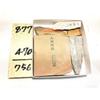
The power of locally sourced and produced materials!!
Please refer to the box dimensions listed above. Weight indicated is the packaged weight. Please use this as a reference for size comparison.
The grain is clear, making it easy to work with and yielding a high rate of usable material when dividing the stone. We encourage you to actually try dividing and shaping the stone yourself to verify the properties and performance differences.
It contains a variety of types, sizes, and shapes. For blades you intend to sharpen, use a stone with ample size to create a flat surface. Otherwise, divide the stone into smaller pieces and use it similarly to sharpening Japanese swords.
It is composed solely of **first-class mineral deposits** from the easternmost part of Kyoto City’s Ukyo Ward, along with comparative samples.
The Umegehata whetstone comes exclusively from Mukonouchi-cho in Umegehata, known for its Nakayama and Koyama deposits, and from Okudono-cho, considered the birthplace of Kyoto whetstones and famous for its Ayameya Valley.
This is a set that doesn’t compromise on quality, avoiding stones bulked up with inferior material. Genuine quality is discernible by how the stone splits. The stone preparation was primarily carried out by trainees under the supervision of an instructor with over 15 years of experience in the Yamamoto-style forging technique. We believe they have successfully split, sorted, and created a colorful assortment of stones, so please check the images.
We encourage you to try splitting it yourself and observe the significant differences in its properties, including the vibrant color variations. (Prepare a flathead screwdriver, mallet, safety glasses, and gloves.)
Having even one soft, reddish-pink stone is a stroke of luck. (Please understand this depends on the batch.)
Clear grain in the original stone easily produces a flaky slurry resembling a film.
Sharpening particles with directionality are arranged on the flakes, resulting in surprisingly strong sharpening power.
The particle size increases with the breakdown of the flakes when water supply is restricted.
The sliding between flakes is lubricated by the crushed mud of tenacious feldspar and mica minerals, creating a smooth gliding sensation.
Historically, it’s akin to replacing the *konbu* (kelp) used to slide heavy stones for Osaka Castle’s walls with crushed flakes.
Excessive pressure during sharpening with too many unbroken flakes can create shallow scratches on softer metals due to the overlapping flakes and the strong sharpening power originating from Yamashiro Province.
Adjusting the pressure, sharpening angle, slurry amount, and water supply will improve your technique and reduce these shallow scratches.
The visible results allow for easy self-assessment and improvement of your technique, making it recommended.
Experienced flake users will likely discover that the aforementioned *konbu* attack is very helpful when dealing with stubborn, hard stones that are difficult to sharpen.
It may rekindle your motivation to re-challenge stones you previously gave up on. It’s generally the job of a whetstone artisan to remove unruly grain through forging, but…
The market tends towards shortcuts in manufacturing, prioritizing thickness and size for larger profit margins. Therefore, you may find opportunities to use the soft, reddish-pink slurry.
・Includes one finished 240g whetstone. Size is based on the outer dimensions of the box. One stone, including the outer box and rough forging stone, weighs 503g. These are whetstones from Iyū Province, Seihonzan, and Yamashiro Province – mid-to-high grade whetstones – with miners hand-writing the name to prevent false labeling and counterfeiting. The forging shown in the image is sealed with extra space. The original stone does not have a name written on it, so please touch and judge its properties yourself. This is geared towards those with a competitive and training-oriented approach.
・Neutral and rust-resistant whetstone from Tangawa Village, Iyū Province, revived after half a century!! https://bit.ly/IyoMIkantsubu The outer dimensions of a 10-stone box of Higo-no-kami (approximately): 12 x 15 x 2.8~5.4 cm. Thickness varies. (It actually overflows and bulges.) Total weight including the box is approximately 503g. We’ve eliminated the popular gacha (random draw) element. You will receive the stone shown in the picture.
・Please polish and flatten the forging. If it doesn’t sit well, apply a wet cloth or use silicone adhesive on a non-deformable base. Mining is done with heavy machinery, and cutting is done with diamond tombstone cutters. We are not involved with products that falsely claim to be “Iyū Meito” whetstones. “Iyū Meito” whetstones since around 2007 are made only from *sazare* (pebble) whetstones. All markings other than small pieces are handwritten for this distinction. We cannot answer inquiries about “Iyū Meito” stones selected and manufactured by others.
・Siliceous shale from Umegehata, Kyoto City, Ukyo Ward, Yamashiro Province. #6,000~24,000 grit. Somewhat hard and requires skill, but has a higher probability of achieving a fine finish. Due to the continuous circular scratches, it is difficult to achieve a mirror finish with 70% of the cutting power and artificial whetstone grit. It easily reveals forging lines, material differences, and contrasts due to carbon content.
・The harder the stone and the more refined the slurry, the more likely it is to be fine. Because hardness reduces self-sharpening, perform *kyōmeikake* (lapping) as needed depending on the purpose and skill level while sharpening.
【Voltage Compatibility】
When using electrical appliances, please note that they are designed for Japanese voltage specifications (90-110V), so if you use them with a different voltage, it may cause a malfunction.
【Plug Type】
Our products use Japanese plug types (A or B type).
Please use a conversion adapter if necessary.
【Important Note on Transformers and Adapters】
A transformer adjusts voltage to match your device's requirements.
A conversion adapter only changes the plug shape and does not adjust voltage.
Using only a conversion adapter without a transformer may result in damage to the product.
【Liability】
We are not responsible for malfunctions or damages caused by improper use, such as operating the product without a transformer.
![[Tensho] Natural Whetstone Yamashiro-Mei Koppa Stone 240g with Iyo-Mei Stone](https://img-edg.joomcdn.net/d3a057637844d56f52bd36a442c50d7a56aeb02c_original.jpeg)
![[Tensho] Natural Whetstone Yamashiro-Mei Koppa Stone 240g with Iyo-Mei Stone](https://img-edg.joomcdn.net/3cd53b508383f29384c2a459044d78c25b110a6f_original.jpeg)
![[Tensho] Natural Whetstone Yamashiro-Mei Koppa Stone 240g with Iyo-Mei Stone](https://img-edg.joomcdn.net/c642079da829c61c05e973c38c76653da9779551_original.jpeg)
![[Tensho] Natural Whetstone Yamashiro-Mei Koppa Stone 240g with Iyo-Mei Stone](https://img-edg.joomcdn.net/733e8781e7477608fe6b7f8fb1f5fde9971fd135_original.jpeg)
![[Tensho] Natural Whetstone Yamashiro-Mei Koppa Stone 240g with Iyo-Mei Stone](https://img-edg.joomcdn.net/f86fed099675de031f271998816bd2974563a0f9_original.jpeg)
![[Tensho] Natural Whetstone Yamashiro-Mei Koppa Stone 240g with Iyo-Mei Stone](https://img-edg.joomcdn.net/8595bcc7b38f6cb775ea3690d7b12c6f74cba7cb_original.jpeg)
![[Tensho] Natural Whetstone Yamashiro-Mei Koppa Stone 240g with Iyo-Mei Stone](https://img-edg.joomcdn.net/e551a779ec7d062bc1f22c521cae5d5e9c750fd5_original.jpeg)
![[Tensho] Natural Whetstone Yamashiro-Mei Koppa Stone 240g with Iyo-Mei Stone](https://img-edg.joomcdn.net/be66eb87623010c0f075be26ea6721c0205ae776_original.jpeg)


 Товар из Японии


 Возврат по недоставке


![[Тэнсё] Натуральный точильный камень Ямасиро-Мэй Камень-обломок 344 г с камнем Иё-Мэй](https://img-edg.joomcdn.net/5c9cc8650c7ee8b00ec3a2683c13dcdd1fa95c1f_100_100.jpeg)




![[Тэнсё] Натуральный точильный камень Ямасиро-Мэй Каменные осколки Домен Озу Деревня Тангава, Камень Иё Для ношения на природе Окуден, Накаяма, Оцубу, Аямея](https://img-edg.joomcdn.net/9cb040469c717f921e9a7bbbdd3d0f6006dd54d0_100_100.jpeg)