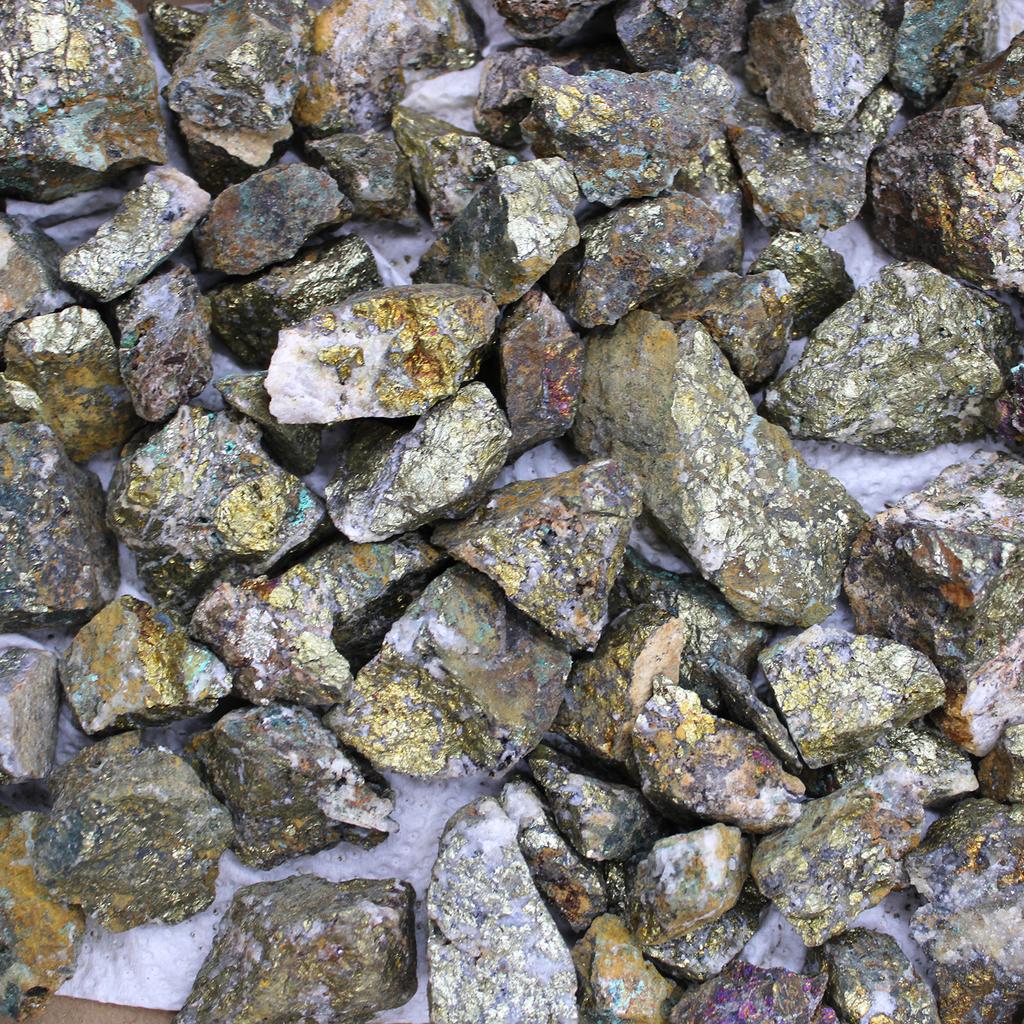
Brassy gold catches the light across these raw chalcopyrite mineral specimens, broken by earthy rust, grey and pale stone tones. They are made for collectors, crystal shelves and mindful display, where the appeal is in the natural roughness rather than a polished finish.
Brassy flashes and natural rough texture
The surface shifts between metallic gold, olive-grey and warm brown, with a speckled look that rewards close viewing.
Each piece has an irregular raw outline, so the lot feels gathered from the earth rather than shaped for symmetry.
Pale areas of natural matrix soften the metallic shine and give the specimens a more rugged, mineral-collection character.
The broken faces show small glittering points and uneven planes, catching light differently as you turn them.
They suit a display tray, study shelf, teaching collection or crystal cabinet where texture matters as much as colour.
Copper-gold mineral from Morocco
Chalcopyrite is a copper iron sulphide, recognised for its brassy metallic lustre and earthy golden colour. It belongs to the tetragonal crystal system and is softer than quartz, so raw pieces should be handled with care rather than treated like hard decorative stones. These specimens come from Morocco.
How to display and handle it
Place the pieces on a tray, in a shallow bowl, or among other mineral specimens where their metallic surfaces can catch natural light. Keep them dry, dust them gently with a soft dry brush or cloth, and avoid washing, soaking or placing them in drinking water.
Chalcopyrite in crystal practice
Alongside its mineral-collector appeal, chalcopyrite is also used in contemporary crystal practice as a stone associated with the chakra system. Practitioners often keep it as a focus object during meditation or intention-setting, drawn to its bright, changeable surface and copper-gold colour.
Size and details
This lot contains 80 raw chalcopyrite specimens with a total weight of 3900 g. Individual pieces vary nat…
region of manufacture: Morocco




 Товар из Великобритании


 Возврат по недоставке