All products sold in our store are manufactured for the Japanese domestic market. Therefore, please note that depending on the manufacturer and the product, specifications may differ from those in your country of residence, even for the same product.
【Voltage Compatibility】
When using electrical appliances, please note that they are designed for Japanese voltage specifications (90-110V), so if you use them with a different voltage, it may cause a malfunction.
【Plug Type】
Our products use Japanese plug types (A or B type).
Please use a conversion adapter if necessary.
【Important Note on Transformers and Adapters】
A transformer adjusts voltage to match your device's requirements.
A conversion adapter only changes the plug shape and does not adjust voltage.
Using only a conversion adapter without a transformer may result in damage to the product.
【Liability】
We are not responsible for malfunctions or damages caused by improper use, such as operating the product without a transformer.
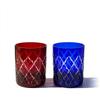
[Product Number] TB94400ARB [Body Size] Φ65×H50(mm) [Capacity] Approx. 90ml [Material] Soda Glass
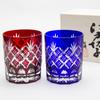
Contents: Paulownia wood box x 1, Edo Kiriko glass x 2, Product description bookmark x 1
Care Instructions: Glass is sensitive to temperature changes, so please avoid sudden cooling or heating. Do not use in a microwave, oven, dishwasher, or dish dryer. When washing, use dish soap and gently rub with a soft sponge or cloth. Rubbing vigorously with a metal scouring pad will scratch and easily break the glass.
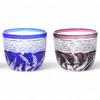
This piece features a combination of two representative traditional Edo Kiriko patterns: the "Yarai" pattern and the "Nanako" pattern. "Yarai" refers to a shape made of bamboo or logs arranged in an alternating pattern. Because Yarai fences are in the initial stages of castle construction and stage design, they symbolize "creating a foundation" and "solidifying the base." "Nanako" refers to fish scales and has the meaning of "many," which in turn represents "fertility" and "abundance." Both are traditional patterns that have been loved since ancient times and are considered very auspicious. The "four-leaf clover" is considered a symbol of good fortune, love, sincerity, and hope, and is said to be very lucky, making it a welcome gift or souvenir for overseas.
Edo Kiriko glasswork originated in the Edo period and has been designated a traditional Japanese craft as a valuable craft that conveys the lifestyle of Edo to the present day. Every piece is handcrafted by skilled artisans.
Edo Kiriko, a traditional craft that originated in the Edo period and conveys the lifestyle of Edo to the present day, is designated as a traditional Japanese craft. Skilled Edo Kiriko artisans meticulously handcraft each piece. The four-leaf clover at the rim of the glass is considered a symbol of good fortune, love, sincerity, and hope, and is said to be very auspicious, making it a welcome gift or souvenir for overseas visitors.


 Товар из Японии


 Возврат по недоставке