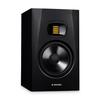
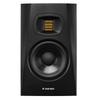
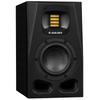
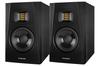
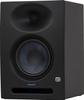
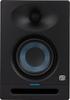
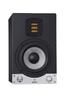
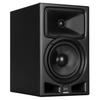
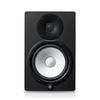
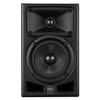
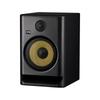
The Adam Audio T8VT8V is an affordable, professional, 2-way studio monitor with an 8˝ woofer, and is Adam Audio's latest addition to the T Series. Designed with the same technology, features, and quality as its smaller sibling, the Adam Audio T8V delivers best-in-class audio response and performance.The Adam Audio T8V impresses with a host of features that deliver real benefits to the user: The 4:1 velocity transfer ratio of the U-ART tweeter, combined with the new high-dynamic-range Class-D amplifier, results in a corresponding maximum peak SPL of 118 dB per pair. The tweeter, which extends to 25 kHz, works as an assembly with the HPS Waveguide. This allows for optimal high-frequency radiation, meaning a more controlled, larger, and usable sweet spot for monitoring. With bass extension down to 33 Hz, the Adam Audio T8V is particularly suitable for users who produce music with strong bass. The T8V is the ideal studio speaker for those who have always wanted to work with an 8-inch Adam Audio monitor, but the budget was insufficient.Modern TechnologyAdam Audio monitors have gained a worldwide reputation as a superb tool for sound engineers, based on the technological innovations we have created in the field of loudspeaker technology.U-ART High Frequency TransducerThe new U-ART 1.9″ ribbon tweeter used in the T Series is made from a technologically advanced polymer film and delivers pristine and extended high-frequency response up to 25 kHz. Virtually unheard of in monitors in this price range, and a breakthrough solution for high-resolution recording and mixing on a budget. Unlike traditional dome or cone tweeters, which use a piston-like action to move air and reproduce sound, the U-ART tweeter uses a pleated ribbon that alternately pulls and compresses air into its folds, causing the folds to expand and contract accordingly in response to the injected audio signal. This design creates four times more air movement than a piston-based design, creating higher sound pressure levels (SPLs) with lower distortion.The U-ART tweeter features a precision waveguide with the same dispersion control properties as the High Frequency Propagation (HPS) waveguide used in Adam Audio's flagship S-Series studio monitors. The waveguide's highly uniform high-frequency dispersion provides an incredibly wide sweet spot that allows for greater freedom of movement during operation.HPS WaveguideThe HPS (High-frequency Propagation System) waveguide was initially designed by Adam Audio for the S-ART S-Series tweeter using the latest computer modeling techniques. It enhances the driver's dispersion to an even, uniform coherence, broad on the horizontal axis but tightly focused in the vertical plane. This minimizes potentially distracting reflections from the horizontal surfaces of large studio furniture (e.g., mixing consoles), ensures consistent image quality, and creates a large, well-controlled, and stable "sweet spot," even at high output levels.The U-ART tweeter used in the T Series features a precision waveguide with the same dispersion control properties as the HPS waveguide used in Adam Audio's flagship S Series studio monitors.PWM – Pulse Width ModulationIn recent years, amplifier technology has undergone a second major shift, following the transition from tubes to transistors some 40 years ago. Semiconductors can still be found in this new generation of amplifiers, but the signals to be amplified are treated in a completely new and different way.PWM (Pulse Width Modulation) – sometimes called Class D amplification, sometimes called Switching Amp technology – converts the incoming signal into a series of equal-height square waves. The width of the rectangles varies over time, and the ratio of the rectangle widths represents the music signal. This wave can be amplified much more simply because the transistors are no longer modulated; instead, they are used as switches that simply turn the supply voltage on and off.It is possible that a very fast mechanical switch could do the job, but power transistors are a better choice, so PWM amplifiers still operate quite like conventional Class AB designs. It should be noted that there are no bits and bytes involved, so "Digital Amplifier" is a misleading and inaccurate term.Advantages of PWMThe main advantage of PWM amplifiers is their extremely high efficiency (>90%). Consequently, the heat to be dissipated is only one-fifth of previous designs, leading to significantly lower temperatures within the amplifiers and making the use of heat sinks unnecessary.This principle has been known for decades, but it took time to develop devices that, while maintaining the previously mentioned high efficiency, provide the best quality of sound reproduction. Adam monitors utilize new technology for both the amplifier and power supply sections (i.e., no more transformers) combined with state-of-the-art input sections and filters to achieve the best results in multi-channel active studio monitoring.


 Товар из Польши


 Возврат по недоставке