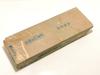
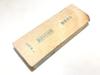
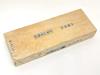
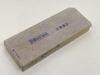
The invention of the Japanese sword led to the emergence of natural whetstones from Yamashiro Province, within present-day Kyoto City. Possessing a history of nearly 900 years, dating back to the late Heian period, it is renowned as the most refined and prestigious whetstone among those derived from slate-like rock.
It was a vital strategic resource throughout the age of the sword, managed by the ruling shogunate from the Kamakura to the late Edo periods. In terms of values up until the modern era, it possessed characteristics akin to industrial materials, comparable to uranium ore essential for nuclear weapons, necessitating strict management.
Iyo Province’s whetstones are believed to have already circulated through the Seto Inland Sea during the Kofun period, and are celebrated as the foremost authority in the world’s oldest and largest industry of whetstones derived from igneous rock, with a history of over 1,500 years.
Our nation’s whetstone resources possess the power to alter nations and transform entire countries. Due to a scarcity of iron ore and the inferior yield of the unique Japanese sand-iron smelting process, combined with Japan’s remote island location, it became the final destination for iron imports—a fatal condition for creating an iron civilization, as if losing limbs.
The very consumables that allow for the creation of harder, more resilient iron products at will are our nation’s whetstone resources—a fact proven by history and tradition. Despite unfavorable locations for construction, Japan came to possess both the world’s oldest and largest wooden structures. Despite being a latecomer to a marginal region, it achieved the invention of world-class iron products during the medieval period, sustaining an era of swordsmanship for nearly 700 years.
Given that most of recorded history belongs to the Iron Age, iron tools became our hands and feet, the very medium for creation. The fact that Japan is known today as a nation of craftsmanship can be proven by the fact that as far back as the ancient Asuka period, around 1,300 years ago, during the construction of Horyu-ji Temple, it already possessed the world’s strongest iron products and tools. This was a natural progression, wasn’t it?
It is true that even in the face of adversity, such as losing limbs, Japan overcame the challenges of forging iron. The irreplaceable, rare, and authentic nature of our whetstone resources overcame the limitations of sharpening during steel development, eliminating them with the exceptional performance of the whetstone. In terms of assessing our nation’s various resources according to values up until the modern era, despite the fact that 70% of our land is covered in mountains and forests, we are a resource-rich nation.
However, it is precisely because the Japanese archipelago is formed by five tectonic plates that we were permitted to extract whetstones in various locations, in exchange for enduring numerous natural disasters. Our hearts, accepting dominance by mountainous and majestic natural environments that combine severity and abundance, may have gradually cultivated patience, cooperation, and compromise, and foreseen the existence of nature worship and the eight million gods (various resources and blessings), elevating them to the foundation of Shinto spirit. This is what would continue to tell the story of Japan’s greatest strengths and charms, which allow for relative tolerance and absorption of foreign cultures and religions, and which transcend mere material happiness.
・77 x 223 x 38 mm, 1,426g. A hard, black whetstone that produces a dark liquid.
・Softens when scratched. An all-purpose tool.
・From Kayabukata, Ukyo Ward, Kyoto City, Yamashiro Province. Silica slate rock, #6,000~24,000 grit. It tends to be hard, but requires careful kneading to achieve fine results. Due to the rounded, continuous striations, it has a long lifespan of approximately 70% and is less likely to produce a mirror-like finish compared to artificial whetstone grains, making it easier to highlight differences in forging lines, material, and carbon content.
・The darker the rock liquid, the harder and more refined the stone tends to be. Because hardness reduces sharpness, sharpen gradually, performing nagura (a technique of creating a slurry) as needed, depending on the purpose and kneading.
【Voltage Compatibility】
When using electrical appliances, please note that they are designed for Japanese voltage specifications (90-110V), so if you use them with a different voltage, it may cause a malfunction.
【Plug Type】
Our products use Japanese plug types (A or B type).
Please use a conversion adapter if necessary.
【Important Note on Transformers and Adapters】
A transformer adjusts voltage to match your device's requirements.
A conversion adapter only changes the plug shape and does not adjust voltage.
Using only a conversion adapter without a transformer may result in damage to the product.
【Liability】
We are not responsible for malfunctions or damages caused by improper use, such as operating the product without a transformer.


 Товар из Японии


 Возврат по недоставке