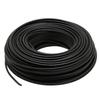
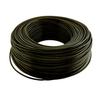
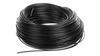
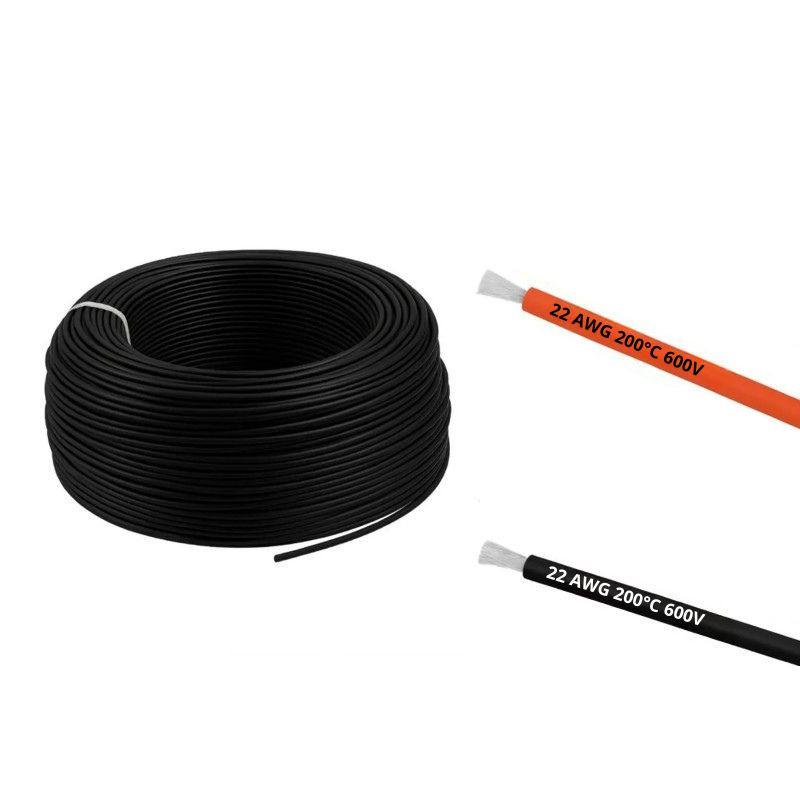
PTFE Teflon Wire 22 AWG 0.321 mm2 - Tinned Copper, 600V
PTFE Teflon Wire 22 AWG 0.321 mm2 is a high-temperature wire for electronics, sensors, service harnesses, and connections requiring greater thermal resistance than typical PVC-insulated wires. It is suitable for soldering, signal routing, and light-duty power connections in electronic devices.
The tinned oxygen-free copper conductor facilitates soldering, improves terminal resistance to oxidation, and allows for clean connections in small systems. Size 22 AWG provides a larger cross-sectional area than 24-26 AWG, so it is practical where the signal wire must be mechanically more reliable or carry a slightly higher load.
• Size 22 AWG / 0.321 mm2 - wire for assembly connections, signal connections, and light power lines.
• PTFE Teflon insulation - high temperature resistance and less risk of insulation damage during soldering.
• Tinned oxygen-free copper - easier tinning of terminals and a more stable soldered connection.
• Rated voltage 600V - a useful parameter for workshop installations and projects requiring a reserve of insulation.
• Outer diameter 1.3 mm - The wire is still relatively thin, but clearly more mechanically robust than 26 AWG.
• Black and red colors - quick polarity marking or separation of wires in a bundle.
Who is this wire for?
• For soldering shops and workshops that need a wire resistant to the temperature of the soldering tip.
• For people building wire harnesses for electronics, robotics, modeling, and FPV.
• For users who want a wire that is stiffer and more thermally resistant than a typical PVC wire.
• For projects where the colors black and red are to clearly indicate the minus and plus of the power supply.
Who is NOT this wire for?
• This is not a wire for the main power supply of large ESCs, LiPo packs, XT60 or high-current installations.
• No Replaces the thick silicone wires used in 5-inch drones on the main power line.
• It won't be as soft as silicone wire - PTFE insulation is more thermally resistant, but usually less flexible.
Why does PTFE make sense in a workshop?
PTFE insulation withstands temperature better than popular PVC insulation. When soldering thin boards, connectors, sensor modules, or flight controllers, the wire deforms less from accidental contact with the soldering tip.
With 22 AWG wire, this is especially important when the tip requires longer heating, for example, with a larger solder pad, branching wires, or repairing an old harness. PTFE reduces the risk of insulation retraction and helps maintain a neat wire termination.
• Signal and control connections in electronics.
• Light-duty power connections for small modules.
• Wire harnesses in devices, housings, and DIY projects.
• Service of FPV electronics, sensors, controllers, and peripheral modules.
• Prototyping, repairs, and soldering work at elevated temperatures.
• Black - most often used for ground, negative, or neutral wires in a harness.
• Red - most often used for positive power or wires requiring quick marking.
Parameter | Value
Product Type | High Temperature Hook-Up Wire
Insulation Material | PTFE Teflon
Wire Size | 22 AWG
Cross-Section | 0.321 mm2
Reference Cross-Section for Design Data | 0.35 mm2
Conductor Material | Tinned Oxygen-Free Copper
Conductor Construction | 19x0.16 mm
Conductor diameter | 0.8 mm
Insulation thickness | 0.25 mm
Outer diameter | 1.3 mm
Resistance at 20C | 49.5 Ohm/km
Rated voltage | 600V
Operating temperature | up to +200C
Colors in this product | Black, red
Cable Shape | Round
• 1 m of PTFE Teflon 22 AWG wire 0.321 mm2 in your choice of color
FAQ - Frequently Asked Questions
Is PTFE 22 AWG wire suitable for soldering electronics?
Yes. PTFE insulation tolerates high temperatures well, so the wire is suitable for soldering electronic modules, sensors, small boards, and service harnesses.
What is the difference between 22 AWG and the thinner 26 AWG wire?
22 AWG has a larger cross-section, is mechanically more reliable, and is better suited for connections that require more robustness than typical thin 26 AWG signal wires.
Can this wire be used to power an ESC in an FPV drone?
Not as a main power line. 22 AWG can be used for lighter power and signal connections, but for powering an ESC, XT30, or XT60, a thicker wire with the appropriate cross-section should be selected.
Why use black and red?
Black and red make it easy to quickly mark polarity. In workshop practice, red most often indicates positive, and black ground or negative.
Avifly expert tip: With 22 AWG PTFE wires, it works well to tin the ends with a thin layer of solder beforehand. This shortens the heating time on the pad and reduces the risk of overheating the solder pad.
Color: nan
Size: nan



 Товар из Польши


 Возврат по недоставке