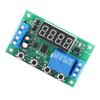
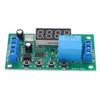
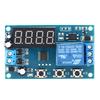
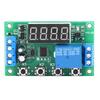
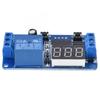
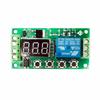
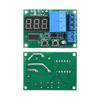
Semi-finishedproduct : No
Data Record : No
High-concerned chemical : none
Shape : others
Electronic : No
Material : Plastic
Size : Relay Module
Type : Relay Module
Model Number : Relay Module
DIY Supplies : Electrical
Brand Name : Aideepen
Origin : Mainland China
Output Voltage : Relay Module
Style : Relay Module
Certification : NONE
Features:
1. Fully upgraded to Version 3.0, switching from high-level triggering to low-level triggering to accommodate a wider range of applications;
2. Replaced the microcontroller + HC595 display circuit with a single-chip integrated control and display solution, reducing the number of components and improving stability;
2. Added reverse polarity protection for the power supply to prevent module damage caused by incorrect power connection;
3. A high-voltage-rated power supply module has been adopted to replace the previous discrete power supply, making the system more stable and reliable;
4. A 0.1-second timing function has been added, upgrading the timing precision from 0.1 seconds to 0.01 seconds;
5. An automatic power-saving feature has been added, which users can configure themselves;
6. All settings are automatically saved and will not be lost in the event of a power outage.
Function 1:
Timed Engagement: After power-on, the relay engages after a delay of T1. T1 is adjustable between 0.1 seconds and 270 hours, sending a low-level pulse signal to the IN1 interface. This function repeats at least once;
Function 2:
Timed De-energization: Upon power-up, the relay energizes; after a delay of T1, the relay de-energizes. T1 is adjustable between 0.1 seconds and 270 hours. A low-level pulse signal is sent to the IN1 interface, and this function repeats one or more times;
Function 3:
Timed Engagement and Disengagement: Upon power-up, the relay does not engage immediately; it engages after the delay time T1 has elapsed. The relay disengages after the engagement time T2 has elapsed. The delay times T1 and T2 are adjustable between 0.1 seconds and 270 hours. Apply a low-level pulse signal to the IN1 interface to repeat this function one or more times;
Function 4:
Timed Disengagement Followed by Engagement: Upon power-up, the relay engages immediately; after the delay time T1 elapses, the relay disengages; after the disengagement time T2 elapses, the relay engages. The delay times T1 and T2 are adjustable between 0.1 seconds and 270 hours. Apply a low-level pulse signal to the IN1 interface to repeat this function one or more times;
Function 5:
Infinite Loop Timed Mode 1: Upon power-up, the relay does not initially engage; it engages after the delay time T1 elapses. The relay de-energizes after the hold time T2 elapses, then repeats the above cycle. The delay times T1 and T2 are adjustable between 0.1 seconds and 270 hours. Applying a low-level pulse signal to the IN1 interface restarts the above function;
Function 6:
Infinite Loop Timing Mode 2: Upon power-up, the relay engages immediately; after the delay time T1 elapses, the relay disengages; after the disengagement time T2 elapses, the relay engages, and the cycle repeats. The delay times T1 and T2 are adjustable between 0.1 seconds and 270 hours. Applying a low-level pulse signal to the IN1 interface restarts the cycle;
Function 7:
Finite-Cycle Timer Mode 1: Upon power-up, the relay does not engage initially; it engages after the delay time T1 elapses; When the hold time T2 elapses, the relay de-energizes, and the above cycle repeats NX times. Here, T1 and T2 are adjustable between 0.1 seconds and 9,999 seconds, and the number of cycles NX is adjustable between 1 and 9,999. Applying a low-level pulse signal to the IN1 interface will restart the above function;
Function 8:
Limited-Cycle Timing Mode 2: Upon power-up, the relay energizes immediately; the relay de-energizes when the delay time T1 elapses; Once the de-energization time T2 elapses, the relay energizes, and this cycle repeats NX times. In this state, T1 and T2 are adjustable between 0.1 seconds and 9,999 seconds, and the number of cycles NX is adjustable between 1 and 9,999. Applying a low-level pulse signal to the IN1 interface will restart the above function;
Function 9:
Self-locking Relay Mode: Apply a low-level pulse signal to the IN1 interface of the relay to energize it; apply another low-level pulse signal to de-energize the relay.
Function 10:
Triggered Relay Mode: Includes a delayed de-energization function. The relay does not operate upon power-up. Applying a low-level signal to the IN1 interface causes the relay to energize immediately. The relay remains energized even after the IN1 signal disappears. The relay de-energizes once the energization time T1 elapses; T1 is adjustable between 0 seconds and 270 hours.
Note: In this function, if T1 is set to 0 seconds, the behavior changes to: the relay energizes when a low-level signal is present at IN1 and de-energizes immediately when the signal is absent.
Function 11:
Triggered Timed Engagement: The relay does not operate after power-on. When a low-level pulse signal is applied to the IN1 interface, the relay engages after a delay of T1. T1 is adjustable between 0.1 seconds and 270 hours. Repeatedly applying a low-level pulse signal to the IN1 interface repeats the above function;
Function 12:
Triggered Timed Disengagement: After power-on, the relay remains inactive. Apply a low-level pulse signal to the IN1 interface; the relay will energize. After a delay of T1, the relay will de-energize. T1 is adjustable between 0.1 seconds and 270 hours. Repeat this process by applying another low-level pulse signal to the IN1 interface to repeat the function one or more times;
Function 13:
Triggered Timed Energization and De-energization: After power-on, the relay remains de-energized. Apply a low-level pulse signal to the IN1 interface; the relay energizes after a delay of T1. The relay de-energizes after a hold time of T2. The delay times T1 and T2 are adjustable between 0.1 seconds and 270 hours. Repeat the process by applying another low-level pulse signal to the IN1 interface to repeat this function one or more times;
Function 14:
Triggered Timed Disengagement and Re-engagement: After power-on, the relay remains inactive. Apply a low-level pulse signal to the IN1 interface; the relay engages immediately and disengages after the delay time T1 elapses; After the de-energization time T2 elapses, the relay energizes. The delay times T1 and T2 are adjustable between 0.1 seconds and 270 hours. Repeat this function by applying a low-level pulse signal to the IN1 interface more than once;
Function 15:
Infinite Loop Timing Mode 1: The relay does not operate upon power-up. When a low-level pulse signal is applied to the IN1 interface, the relay energizes after the delay time T1 elapses; The relay de-energizes when the hold time T2 elapses, and then repeats the above cycle. The delay times T1 and T2 are adjustable between 0.1 seconds and 270 hours. Repeatedly applying a low-level pulse signal to the IN1 interface will restart the above function;
Function 16:
Infinite Loop Timing Mode 2: Upon power-up, the relay remains de-energized. When a low-level pulse signal is applied to the IN1 interface, the relay energizes immediately and de-energizes after the delay time T1 elapses; When the de-energization time T2 elapses, the relay energizes, and the cycle repeats. The delay times T1 and T2 are adjustable between 0.1 seconds and 270 hours. Repeatedly applying a low-level pulse signal to the IN1 interface will restart the above function;
Function 17:
Limited-Cycle Timing Mode 1: The relay does not operate upon power-up. Apply a low-level pulse signal to the IN1 interface; the relay energizes after the delay time T1 elapses; After the hold time T2 elapses, the relay de-energizes, and the above state repeats NX times. In this mode, T1 and T2 are adjustable between 0.1 seconds and 9,999 seconds, and the number of cycles NX is adjustable between 1 and 9,999. Repeatedly applying a low-level pulse signal to the IN1 interface will restart the above function;
Function 18:
Limited-Cycle Timing Mode 2: The relay does not operate upon power-up. When a low-level pulse signal is applied to the IN1 interface, the relay immediately energizes; after the delay time T1 elapses, the relay de-energizes; After the de-energization time T2 elapses, the relay energizes, and this cycle repeats NX times. T1 and T2 are adjustable between 0.1 seconds and 9999 seconds, and the number of cycles (NX) is adjustable between 1 and 9999. Repeatedly applying a low-level pulse signal to the IN1 interface will restart the above function;
Package Includes:
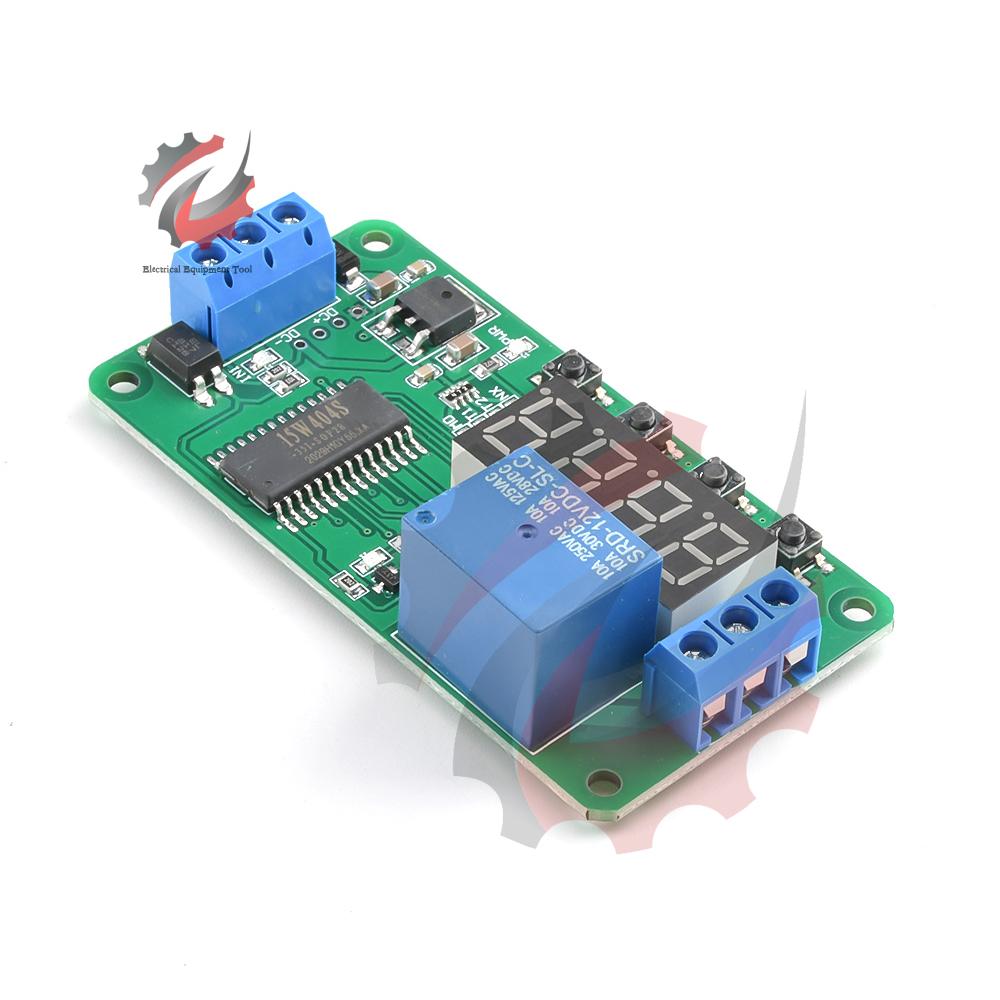
1 x Delay Relay
label:yes
Voltage: 180–260 V




 Возврат по недоставке