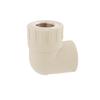
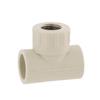
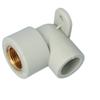
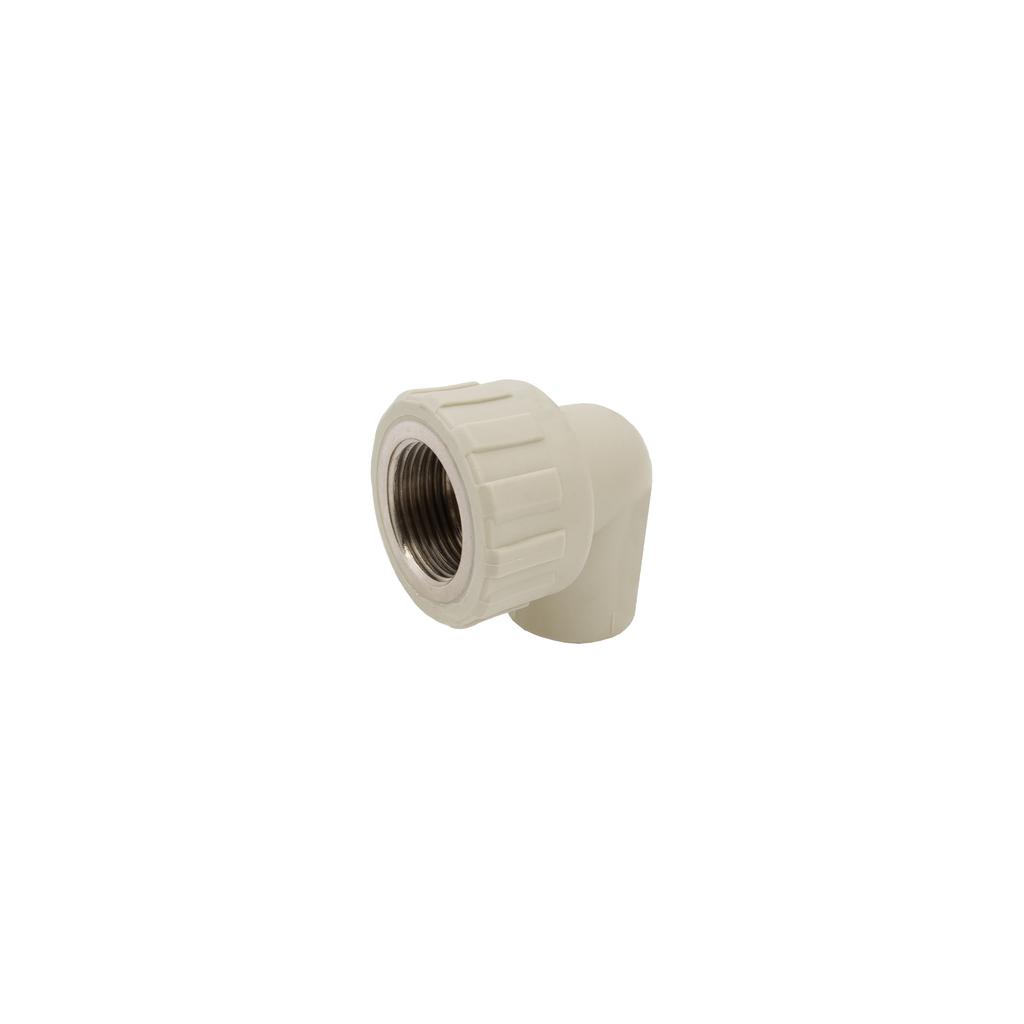
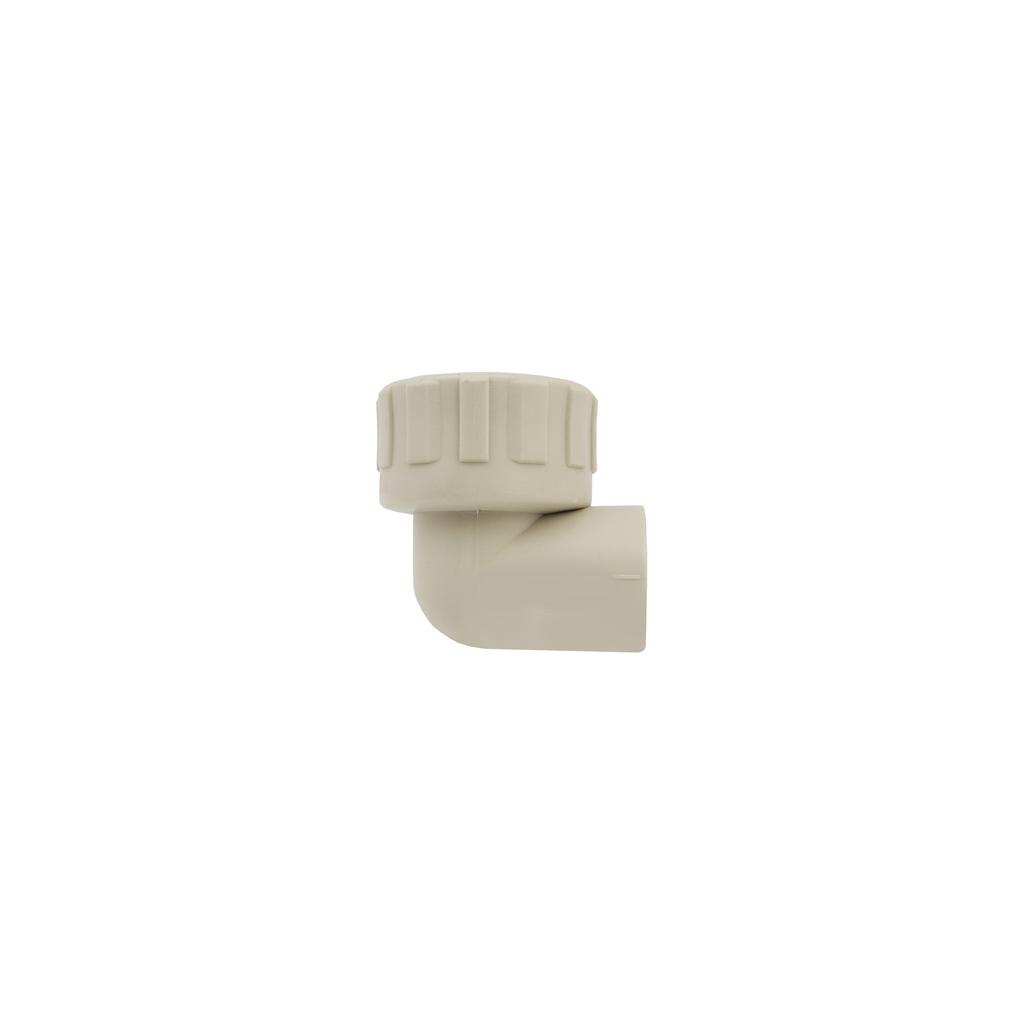
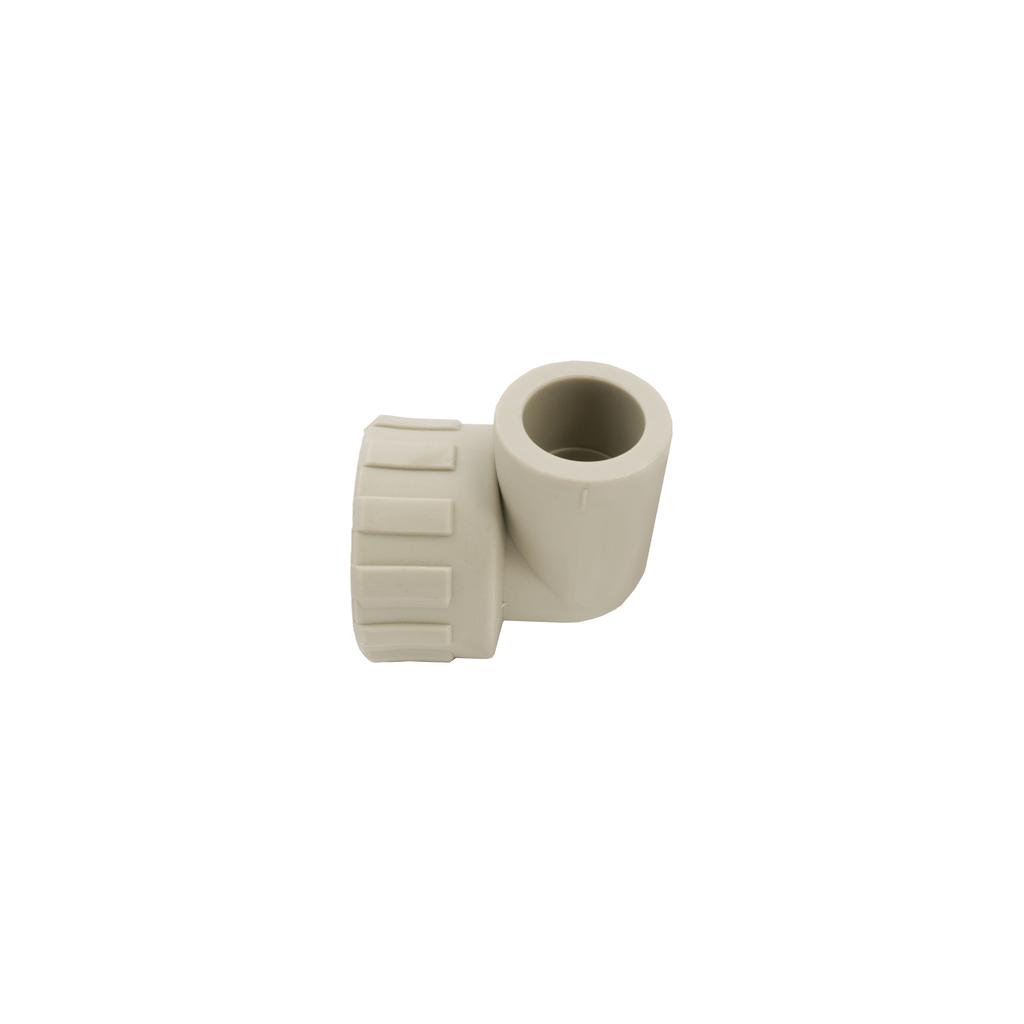
IDMAR PP‑R elbow 90° DN32×3/4" FW – welded + internal thread
Professional PP‑R transition fitting for connecting threaded fittings | Size DN32 (32 mm) × thread 3/4" FW (DN20) | Angle 90° | Working pressure 10 bar @ +60°C, 6 bar @ +80°C | Compliant with PN‑EN ISO 15874‑3:2013 | | 24h shipping ✓
What is the PP‑R elbow 90° DN32×3/4" GW?
The PP‑R elbow 90° DN32×3/4" GW (product code PPRZKGW032X3/4.1009) is a universal transition fitting manufactured by IDMAR, connecting a PP‑R polypropylene pipe with a nominal diameter of DN32 (Ø 32 mm external) with a fitting equipped with a 3/4" cylindrical thread in accordance with the ISO 228-1 standard.
The fitting is made of high-class polypropylene type 3 (random copolymer PP‑R), reinforced Brass threaded insert made of CW617N alloy (58% copper, 39% zinc, 3% lead), resistant to disinfection and corrosion.
The product is intended for installation in cold and hot water, central heating, cooling (chilled water), compressed air, and technological systems in residential, commercial, and industrial buildings.
On one side, the fitting has a socket for polyfusion welding (internal Ø 30.6 mm, embedding depth 20 mm, welding time 8 s at 270 °C ± 5 °C), on the other side a profiled brass insert with a 3/4" (DN20) internal cylindrical thread in accordance with ISO 228-1.
This allows direct connection of sanitary and heating fittings: bath taps with thermostats (flow 20-30 l/min), tropical rain showers (Ø 300-400 mm, Q = 20-35 l/min), high-power radiator valves (3.5-5 kW), mesh and swirl filters (ΔP 3° causes a leak.
Remove burrs with a deburrer or chamfer (chamfer 1-1.5 mm).
4. Marking the fusion depth: For a diameter of 32 mm, the weld depth is 20 mm. Mark the line with a marker on the pipe.
5. Cleaning and degreasing: Wipe the pipe end and the elbow socket with isopropyl alcohol (99%). Impurities weaken the fusion by 30-50%.
6. Heating the elements: Insert the pipe into the inner sleeve of the welding machine (dorn) to a depth of 20 mm, and at the same time slide the elbow socket onto the outer sleeve (die) as far as it will go. Heating time for a diameter of 32 mm: 8 seconds. Do not rotate the elements during heating.
7. Connecting: After 8 seconds, remove both elements simultaneously. Immediately (≤ 6 s) insert the pipe into the elbow socket to a depth of 20 mm – straight, axial movement, without rotation. Hold for 15-20 seconds. An even collar (1-2 mm wide) will appear around the joint.
8. Cooling and stabilization: Leave the joint motionless for minimum 4 minutes (+20 °C). Do not apply mechanical stress during cooling.
9. Weld quality control: Check the uniformity of the flange (360°), pipe axiality (tolerance 50 Nm) – cracking of the brass insert, deformation of the PP-R body, leakage – use a torque wrench or reduce the pressing force
• Incorrect fusion depth ( 6 bar, use 6-8 laps for a 3/4" thread
• Winding the tape in the reverse direction - the tape slips during screwing, no seal - wind in the direction of screwing (right-handed)
• Hot assembly of fittings (PP-R temperature > +40 °C after welding) - deformation of the body, leakage - wait at least 4 minutes after welding before installing the fitting
• Overheating of the pipe during welding (> 10 s) – narrowing the internal lumen by 10-20%, flow decrease, increased hydraulic resistance (noise, vibrations)
Frequently asked questions (FAQ)
Why DN32 with a 3/4" thread (DN20) instead of 1" (DN25)?
The 3/4" thread is the most common standard in bathroom, sanitary and heating fittings in Europe and Poland (≈ 70% of the market). The DN32×3/4" GW elbow combines the high flow capacity of the DN32 pipe (50-65 l/min) with the versatility of the 3/4" thread, eliminating the need for additional reductions.
An ideal choice for installations in multi-family apartments (12-30 units), where a flow of 50-60 l/min ensures comfort while simultaneously drawing water at 2-3 points. The 1" thread (DN25) is less frequently used (≈ 20% of the market) and requires larger fittings/fittings (higher cost, larger dimensions).
Is the elbow suitable for a thermostatic bathtub faucet (Q = 20-25 l/min)?
YES. The flow capacity of DN32 at a velocity of v ≈ 1.0 m/s is ≈ 45-50 l/min, with v ≈ 1.5 m/s ≈ 60-65 l/min. A thermostatic tap requires Q ≈ 20-25 l/min (filling a 180 l bathtub in 7-9 minutes), so the elbow provides a 2-2.5-fold flow reserve, eliminating pressure drops and temperature fluctuations.
For comparison: DN25 provides Q ≈ 30-40 l/min (1.5× reserve), DN20 only Q ≈ 18-22 l/min (1.0× reserve – risk of drops with simultaneous withdrawal).
What is the maximum tightening torque of the 3/4" GW thread?
Can the elbow be used in a +65 °C domestic hot water circulation system?
YES. The elbow can withstand a long-term pressure of 10 bar @ +60 °C and 6 bar @ +80 °C. Domestic hot water circulation of +65 °C is within the operating limits (peak temperature +90 °C permissible for short periods up to 100 h/year in accordance with the PN-EN ISO standard).
15874-3). The safety margin is 1.5-2.0× at a nominal system pressure of 3-4 bar. Recommendation: insulate circulation pipelines with PE or rubber sheathing (thickness ≥ 13 mm) – reducing heat losses by 70-85%, energy savings of 150-250 kWh/year per 10 m circulation riser.
How many assembly-disassembly cycles can a 3/4 internal thread withstand?
When properly tightened (torque 30-35 Nm, Teflon tape 6-8 turns or sealing paste), the CW617N brass insert withstands 5-10 cycles without significant loss of tightness and strength. After > 10 cycles, it is recommended to replace the fitting or use a new sealing ring (O-ring or hemp + paste type).
Note: each assembly-disassembly cycle weakens the thread by 5-10% (microcracks, thread wear), after 15-20 cycles there is a risk of leakage at pressure > 6 bar.
Is the elbow compatible with PP-R pipes from other manufacturers?
YES. All PP-R pipes for drinking water and central heating are dimensionally compliant with the PN-EN ISO 15874-2:2013 standard. The IDMAR DN32 elbow can be welded without any problems with Wavin Ekoplastik (SDR 6, SDR 7.4), Vesbo (PP-R PN 20), FV-Plast (Stabioxy, Stabi), Aquatherm (Green Pipe, Blue Pipe), KAN-therm (PP 80, PP-RCT) pipes provided that the welding parameters are maintained.
(270 °C, 8 s heating, 20 mm depth). Note: check the PP‑R type (type 3 = random copolymer) – type 1 (homopolymer) and type 2 (block copolymer) have different thermal properties.
Is it possible to replace a DN32 steel elbow with a PP‑R one without replacing the fittings?
YES. The PP‑R DN32×3/4" FW elbow is a direct replacement for steel/brass threaded elbows. Advantages of replacement: elimination of corrosion (no rust, scale, green deposits), service life ≥ 50 years (vs.
15-25 years for galvanized steel), better throughput (Q 20-30% higher at the same ΔP thanks to the smooth PP-R surface), less noise (reduction by 3-5 dB), easier assembly (welding 8 s vs. threading 3-5 min).
Procedure: unscrew the fitting from the old steel elbow, install a new PP-R elbow DN32×3/4" GW (weld + thread), screw in the fitting with Teflon tape.
✓ Why do installers and DIY enthusiasts choose us?
• 24h shipping - orders placed before 2 p.m. are shipped the same day by courier (InPost, DPD, Poczta Polska)
• - all products are covered by the full manufacturer's warranty + the possibility of extending it to 5 years years (premium option)
• Threshold discounts: 2% for purchases > PLN 1,500, 3% for > PLN 2,000, 5% for > PLN 5,000 – discount calculated automatically
• Comprehensive PP-R offer: pipes Ø 16-110 mm (PN10/16/20/25), fittings (elbows 45°/90°, tees, sleeves, plugs, reduction transitions), threaded connectors (MZ/GW), ball valves, supports, compensators, tools See the full offer of PP-R fittings
• Approvals and certificates: PZH (drinking water), ISO 9001:2015, declarations of conformity PN-EN ISO 15874-3:2013
Recommended: 30-35 Nm (standard torque for sanitary and heating fittings). Safe maximum: 40-45 Nm (using a sealing ring or paste). Note: at a torque of > 50 Nm the risk of micro-cracks of the insert increases. brass and thread deformation. Use a torque wrench or a wrench with a soft tip. For comparison: a 1/2" thread requires 20-25 Nm (smaller surface), a 1" thread requires 40-50 Nm (larger surface).



 Товар из Польши


 Возврат по недоставке