The original POLION product means uncompromising quality, safety and reliability. The highest quality components and a modern production line allow us to obtain a final product that meets the expectations of the most demanding user.
Car inverter 12V/230V Polion 1200W pure sine
A car inverter is a device that converts direct current with a voltage of 12V to alternating current with a voltage of 230V, which is the standard throughout the European Union and most countries in the world.
Designed for use in passenger cars, campers and other places where there is no access to the electricity grid.
⭐ Intended use:
✅ Powering devices with a wide current consumption range such as: laptops, chargers (e.g. for phones, drones, power tools), TVs, monitors, power tools, small household appliances, etc.
✅ Compatibility with all electrical and electronic devices due to the pure sinusoidal output waveform.
✅ The converter easily supports power tools such as angle grinder or drill.
✅ The converter has been tested with a pressure coffee machine 1450W - it works properly.
⚙️ Technical parameters:
• Condition: new
• Manufacturer: Polion
• Usable power (continuous): 1200W
• Power Instantaneous: 2400W (<0.1s)
• Nominal input voltage: 12V
• Operating voltage range: 10 - 15V
• Efficiency: ≥90%
• Output voltage: 230V AC 50Hz
• Voltage waveform: pure sine wave
• Power consumption of the converter in idle mode with it on: ~7W at 14V
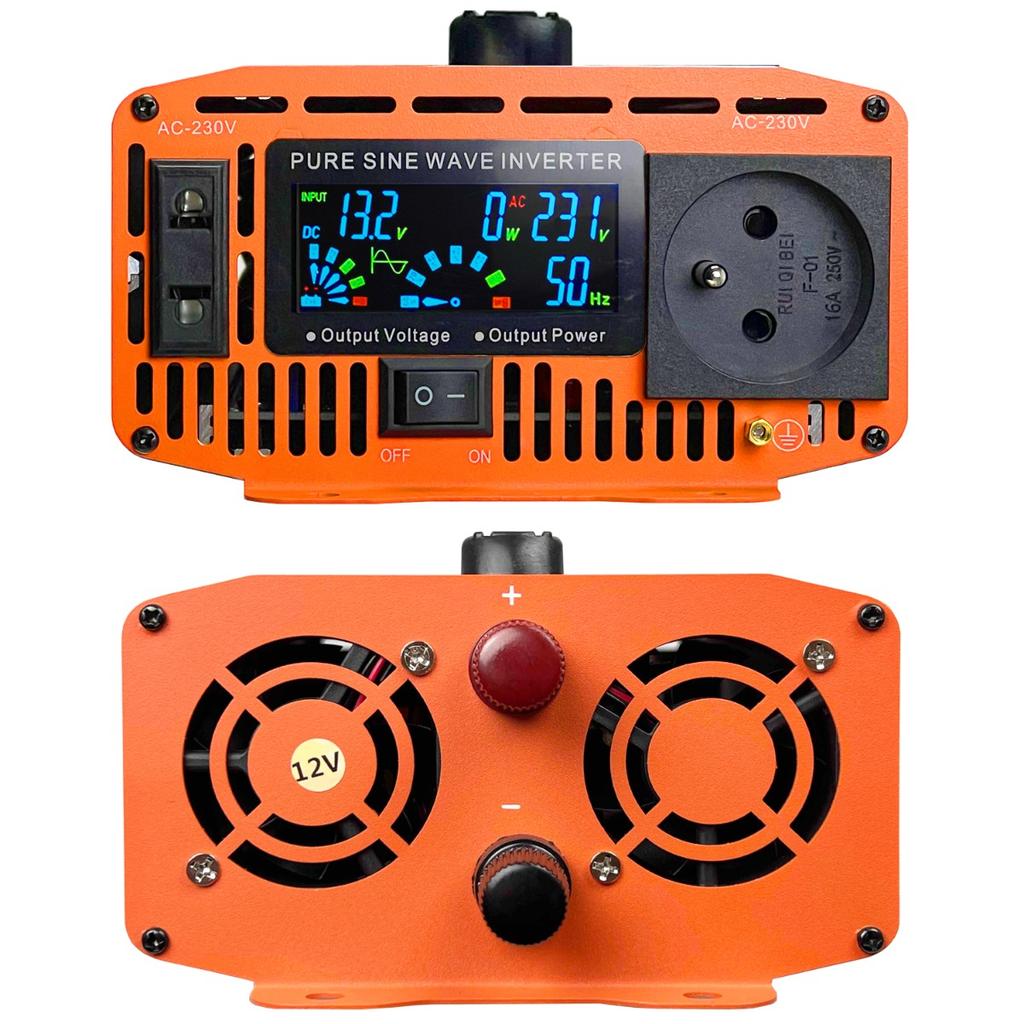
• Output sockets: 2x AC: type E (used in Poland) + Europlug
• Display: yes (input/output voltage, load, frequency)
• Voltage stability: +/- 3%
• Recommended batteries:Lead / AGM / Li-ion
• Protections:DC undervoltage, DC overvoltage, thermal, short circuit, overload
• Dimensions: 15 x 30 x 8 [cm] (width / depth / height). However, when installing, maintain a safe distance required for effective cooling.
• Weight: 1.8 kg
• Stock code: PLNINV005
✅ Output waveform - pure sine wave.
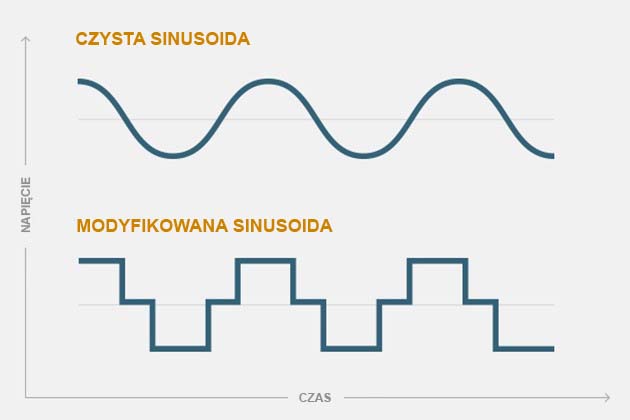
The output waveform of converters is either pure or modified. The choice of converter type depends on the devices it will power.
A pure sine wave is the same waveform as in the power grid. Therefore, it will work correctly with all devices, even those very sensitive to voltage waveforms or those with AC motors.
A modified sine wave is a cheaper and simpler solution. It allows for the correct operation of most electronic devices. However, it is not recommended or harmful to use it with devices that have AC motors, such as refrigerators with a generator or power tools.
While you can connect such tools, and they will work, it is harmful to them. There are other devices that are very sensitive to voltage waveforms, but they are rare.
All our converters are safe for your equipment and generate a pure sine wave.
✅ Full protection of connected devices
An intelligent control system and a fan ensuring adequate cooling are responsible for the proper operation of the equipment and safety. The converter is equipped with a number of specially designed protections ensuring full protection of connected devices, including:
UVP - protection against too low supply voltage,
OVP - protection against too high supply voltage,
OTP - overheating protection,
SCP - short circuit protection,
OPP - overload protection;
✅ Thoughtful Design
The device has been designed for convenient use regardless of your location. The converter housing is made of high-quality aluminum, which is light, durable, and dissipates heat well.
At the back of the converter there are two fans installed to ensure proper cooling and plus and minus connectors to which the battery is connected.
➡️ The set includes:
• Cables for connecting to the battery
• User manual in Polish
General notes on converters.
The supply voltage of most converters is 12V, which is very popular and convenient. However, this has its drawbacks resulting from pure physics, which you should be aware of when using.
• The current on the 12V side can reach very high values. For example, the nominal current for a 1000W converter is ~90A.
High currents require the use of power cables with large cross-sections for two reasons:
• The first, obvious one, is the heating of the cables. This is unlikely to cause the wire to burn out, but it can easily melt the insulation and cause a fire in adjacent materials.
• The second factor is voltage drop, which is very important for a 12V installation. Using a wire that is too thin can easily result in a situation where the voltage on the battery is 12V, but with the converter under load, the wire will drop to, for example, 2V, which will cause the converter to shut down due to insufficient supply voltage.
Therefore, the length and cross-section of the power cables are very important.
When selecting the power of the converter, remember:
• The converter should not operate continuously at full power, so it should be selected so that the rated power of the connected devices is no more than ~80% of the converter's power.
• Some devices draw significantly more power when turned on for a short period of time. For example, all devices with a motor. In this case, the converter's power should be significantly higher to cope with a momentary, significant overload.
The additional power reserve depends heavily on the specific type of connected device, and it is difficult to provide an exact relationship.
• Virtually all converters have DC line fuses. They are built into the converter, soldered in to eliminate contact (due to the high currents involved).
• Internal fuses should never blow during normal operation. They protect the system primarily in the event of a device failure.
• When connecting the converter, we recommend using external fuses on the DC line. We offer them; they should be available for purchase at the top of the list. They should be mounted close to the power source, i.e., the battery.
They then protect the installation against, for example, an accidental short circuit occurring somewhere on the power line leading to the converter, such as a wire chafing to ground, or an accidental short circuit near the converter's DC terminals.
The front of the converter has two mains sockets: type E, used in Poland, among others, and Europlug, designed for RTV plugs without a grounding pin. The E-type has been mounted in a way that allows for trouble-free connection of a cable with an angle plug when the converter is permanently attached to the ground.





 Товар из Польши


 Возврат по недоставке