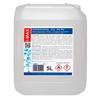
Our water-based GoTherm® thermal insulation coatings are universal products made
from components from leading Polish manufacturers
.
The GoTherm® coating is available in two varieties, commonly referred to as
thermal insulation mass
and
thermal insulation paint
. The mass version (thick product) has a consistency similar to putty and should be applied with a spatula/trowel, while the paint version (liquid product) has a consistency similar to emulsion paints, allowing it to be applied with a brush, roller, or paint sprayer.
GoTherm® is used to create both
external and internal thermal insulation
as well as protective coatings for building partitions,
protection against burns from hot surfaces
.
Prevents condensation
on surfaces with large temperature differences (e.g., external walls with insufficient thermal insulation), preventing the creation of an environment conducive to the growth of mold and fungi.
Sample applications
rooms with insufficient thermal insulation.
rooms with high humidity at risk of mold and mildew,
public facilities such as hospitals, medical clinics, and various types of offices,
historic buildings where, due to the complex shape of the facade, mineral wool or polystyrene cannot be used,
partitions made of brick, plaster, concrete, and wooden elements,
elements of industrial installations.
Eco-friendly and harmless
Our product is water-soluble, making it friendly to both humans and the environment!
While standards allow a maximum VOC (Volatile Organic Compounds) content in paints and varnishes of 30 g/l (for interior use) or 130 g/l (for exterior use),
GoTherm contains only trace amounts of these compounds – 0.6 g/l!
Surface Finish
By painting
with thermal insulation paint
(with a roller or paint sprayer), you will obtain
structure
, which is due to the high content of glass microspheres in the product.
Achieving a smooth finish
is only possible by spreading
the thermal insulation compound
(using a trowel or spatula), which, however, requires experience and skill in applying the plaster.
Coverage
Depending on the application, consumption is 0.5 - 3.0 liters of product per 1 m².
Radiation reflection
– total layer thickness min. 0.5 mm (0.5 l/m²),
Mold and mildew on walls
– total layer thickness min. 1 mm (1 l/m²),
Condensation
– total layer thickness min. 1.5 mm (1.5 l/m²),
thermal insulation
- total layer thickness min. 1-3 mm (1-3 l/m²),
hot surface
(e.g., pipe) - total layer thickness 1.5-3 mm (1.5-3 l/m²).
Technical Specifications
Packaging:
2L, 5L, 10L (GoTherm® paint); 2L, 5L (GoTherm® mass)
Drying time:
from 2 to 24 hours depending on ambient temperature and humidity
Color:
White
Application:
Construction, Industry
Application method:
brush, roller, paint sprayer (GoTherm® paint); Trowel/Plaster (GoTherm® compound)
Maximum unit pressure:
10 bar
Thermal conductivity coefficient
: 0.00053 W/(m*K)
Scattering coefficient (TSR):
90%
Operating temperature
: -30°C to 180°C
Warranty period:
5 years
Frequently asked questions
Can I paint with GoTherm thermal insulation paint or compound myself?
Absolutely, a brush or roller will do! However, please remember that this is not a standard decorative paint, but a thin-layer thermal insulation, so the application may differ from that of regular paints. For painting smooth surfaces, we recommend a short-nap nylon roller (approx. 6 mm). For rough surfaces (such as facades), we recommend a long-nap polyacrylic string roller. For thermal insulation, application is only possible with a putty knife/trowel and requires greater experience and skill in applying materials such as plasters. We recommend performing a test application on a safe area.
Can I cover the paint/thermal insulation with another product?
Our coatings can be painted over with another water-based product (e.g., acrylic paint), but they work best as a final layer, as they work in two ways:
reflects radiation
- thermal radiation is reflected from the coating surface. The product has a thermal conductivity coefficient (TSR) of 90%.
limits thermal conductivity
- works similarly to traditional thermal insulation materials, such as polystyrene.
If our paint is painted over, the radiation reflection effect will be reduced, but the thermal conductivity will still be effective. Technically, there are no contraindications, and you can apply the final coat with a different paint. However, we recommend applying a thicker coat to compensate for the loss in reflectivity.


 Товар из Польши


 Возврат по недоставке