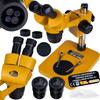
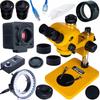
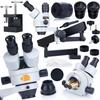
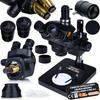
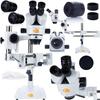
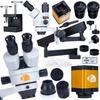
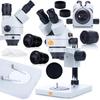
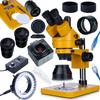
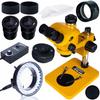
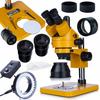
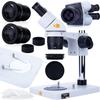
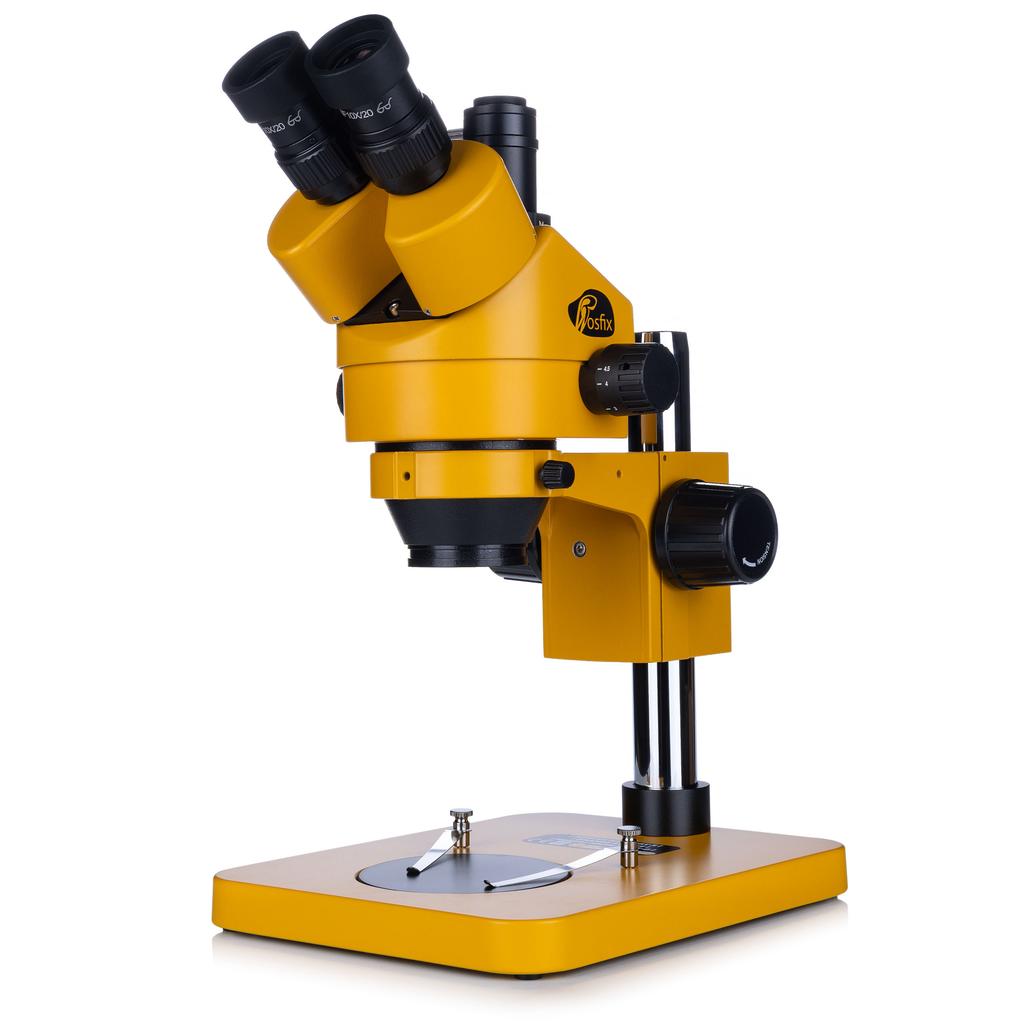
Rosfix Mercury S MSMS-T-PS1-O | Trinocular | Zoom 7-45x | Simul-Focal | WF10X/20 | Working distance 100mm | Orange Series Professional trinocular stereo microscope in the Orange PRO series Optical magnification 7x – 45x with precision zoom 0.7x – 4.5x High-quality Greenough optics – natural colors and excellent sharpness Simul-Focal trinocular – possibility of simultaneous observation and work with a camera Large 100 mm expandable working space – comfortable soldering and inspection Ergonomic 45° inclined head, diopter adjustment and wide field of view WF10X/20 Stable, compact base – ideal for service and laboratory work Orange Series color – distinctive design of the Rosfix series Orange PRO Series – Rosfix Mercury S MSMS-T-PS1-O model Trinocular stereo microscope The Rosfix Mercury S MSMS-T-PS1-O is a compact and professional model from the Orange Series line, combining high-quality Greenough optics with a robust, ergonomic design. Ideal for electronics services, quality control, jewelry workshops and laboratories where precision, comfort, and repeatability are important. Main features of the Rosfix Mercury S model: Precision Greenough optics The optical system made of high-quality glass with anti-reflective coatings ensures sharpness, high contrast and faithful color reproduction throughout the full magnification range. Optical zoom 0.7x – 4.5x (magnification range 7x – 45x) Allows for smooth magnification adjustment and adaptation to the examined object. Simul-Focal Trinocular Trinocular head with the ability to simultaneously observe through the eyepieces and record images with a 25 mm C-Mount camera (camera purchased separately). Ergonomic design The 45° head tilt ensures a comfortable working position even during prolonged work. Adjustable interpupillary distance (52–80 mm) and ±5 diopters on both eyepieces further increase work comfort. Large 100 mm working space Allows free maneuvering of tools during soldering, inspection, and service work. Wide field of view thanks to WF10X/20 mm eyepieces Allows easy orientation in the working field and comfortable observations. Greenough Optical System — this is one of the most popular optical systems in stereoscopic microscopes (binocular and trinocular). How does it work? The Greenough system has two completely independent optical paths (one for each eye). Each of them has its own lens and prisms, thanks to which we achieve: a real spatial (3D) image, a large depth of field, a natural perspective. Why is it used? ensures high contrast and image sharpness, gives a stable, natural image without distortion, is very well suited for electronics assembly, jewelry, quality control, and laboratory work, allows for comfortable and long work without eye fatigue. Specification: Optical system: Greenough optical system Angle of view: 12° Zoom mode: Continuous zoom Magnification range: 0.7x ~ 4.5x Optical zoom: 1:7.1 Eyepieces: WF10X20mm Maximum field of view: 20 mm Optical path Objective lens: 4 elements (without protective glass) Objective field of view: 35 mm Working distance: 100 mm Mounting hole diameter: 76 mm Interpupillary distance: 55–75 mm Eyepiece tube diameter: 30 mm Optical exit path: 4/6 spectral form The complete Rosfix Mercury S MSMS-T-PS1-O microscope set includes: Trinocular head: Allows for simultaneous observations through two eyepieces and allows for mounting a camera for image documentation and analysis. Stable microscope base: Ensures stability and smooth movement of the microscope, which makes it easier to adjust the view to the examined samples. Pillar supporting the entire structure: Provides solid support for the microscope head and ensures its stability. Focus (distance) adjustment arm: Allows for precise adjustment of the focus and the distance between the lenses and the examined object. Clamp stand: Enables secure and stable attachment of the arm. Microscope cover: Protects the microscope from dust and damage during storage and transport. Rubber eyecups: Ensure comfortable use of the microscope and protect your eyes from extraneous light. WF10X/20mm eyepiece (2 pieces): Standard eyepieces with 10x magnification, allowing for comfortable and precise observations. With its complete kit, the Rosfix Mercury Pro microscope is ready for a variety of professional applications. It offers advanced features and capabilities, making it an indispensable tool for researchers, specialists in various fields, and students in the process of learning and exploring the microworld. Maximum magnification: Depending on the configuration (standard, without additional accessories): Standard: 0.7x – 4.5x (zoom) × 10x (WF10X eyepieces) = 7x – 45x When using additional lenses and eyepieces it is possible: Minimum magnification: up to about 3.5x Maximum magnification: up to 270x (e.g. 2x objective lens × 30x eyepieces × zoom) Possibility of expanding the workspace – greater comfort of working with tools The standard working distance of 100 mm is sufficient for many tasks, but when working with a soldering iron, precision tools or larger electronic components, it is worth increasing the distance between the lens and the object . How to do it? Use the 0.5x or 0.7x additional lens – mounted in front of the main lens: lens 0.5x increases the working distance up to ~160–200 mm , lens 0.7x allows you to get ~130–150 mm . Thanks to this, you gain: more space for operating a soldering iron, tweezers, or tools, less risk of accidental damage to components under the microscope, greater visual comfort during prolonged work. Expanding the workspace does not require replacing the head – simply tighten the lens in front of the objective and you're done. This is a very popular solution in electronics repairs, GSM repairs, precision workshops, and for manual work under a microscope. To sum up: Do you want to solder comfortably under a microscope? Use the 0.5x auxiliary objective and you will gain more space, better ergonomics and greater work comfort. This is a minor modification that significantly improves the functionality of the microscope in professional applications. Example Applications: Electronics Soldering: An excellent tool for precise inspection when soldering electronic components. Industrial Inspection: Allows detailed analysis of industrial components for quality control and defect detection. Computer Parts Inspection: Used to examine microcomponents in computers and electronic devices. Telecommunications Module Inspection: Allows for accurate evaluation and diagnosis of telecommunications components. Learning Tool: Ideal for scientific research in schools and universities, allowing students to explore the microscopic world. Laboratory Research: Used in laboratories to analyze samples and microorganisms. Medical Analysis: Used to examine tissues and cells in medicine, aiding diagnosis and therapy. School research tool: Useful in school education, allowing learning through observation of the microworld. Insect and plant examination: Allows detailed examination of the structure and characteristics of insects and plants. Skin examination: Used in dermatology to analyze skin and pathological changes. Textile inspection: Allows to assess the quality of fabrics and detect defects. Jewelry Inspection: Used to examine the detail and quality of jewelry. Collections / Coin Inspections: An excellent tool for collectors to examine the detail and authenticity of coins and collectibles. Print Inspection: Used in the printing industry to assess the quality of printed materials. Difference in magnification range when working with a camera: Please note that the magnification range when observing through the camera differs from that available when observing through the eyepieces: For eyepieces: the standard magnification range is 7x – 45x (with 10x eyepieces). For the camera: the optical magnification range on the screen in a standard configuration is 80x – 120x (converted to screen magnification). This difference results from the different design of the optical path — the camera records the image without additional ocular magnification. Possibility of precise correction of the camera magnification: To provide the user with even greater flexibility and adapt the screen image to their own needs, the Rosfix Mercury S microscope set includes: magnification reducer 0.35x (C-Mount 25 mm) By using this reduction lens: the field of view on the screen is significantly increased, the digital magnification of the camera is reduced, the image becomes more natural and clear – similar to what you see through your glasses. The 0.35x reducer allows you to comfortably work with the camera even on large PCBs where you need to inspect a larger area without losing image quality.




 Товар из Польши


 Возврат по недоставке