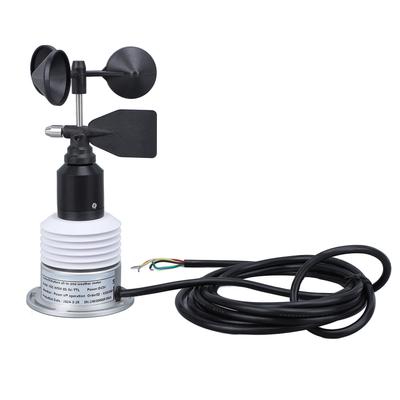
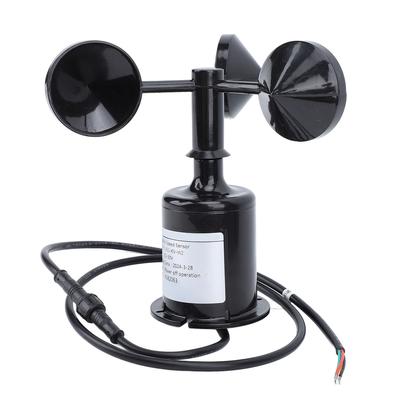
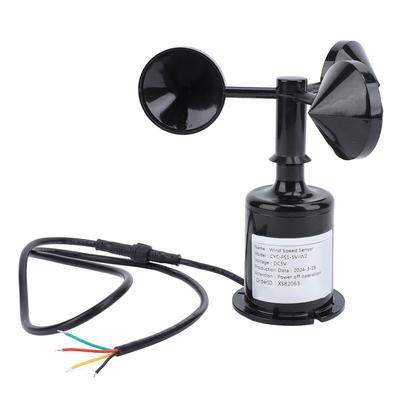
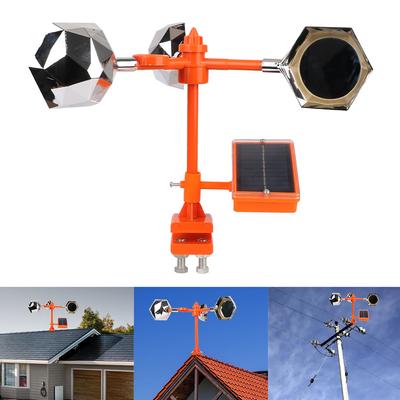
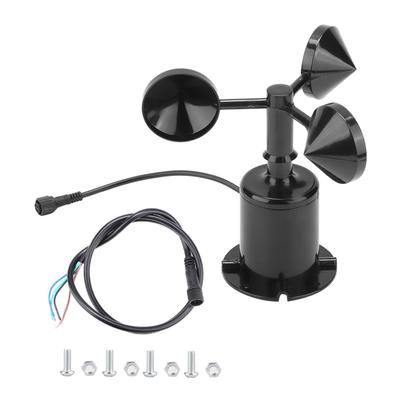
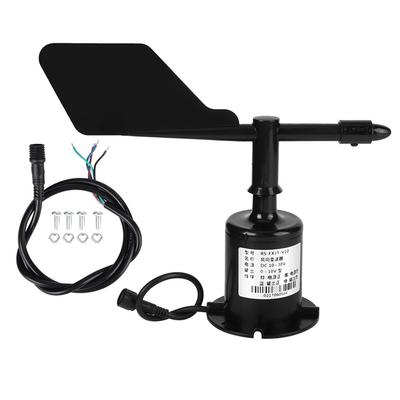
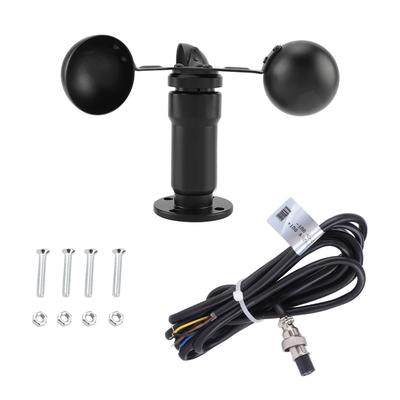
Design: The weather meter is a compact and highly integrated integrated sensor, which is smaller in design and equally powerful compared to traditional integrated environmental sensors.
Multifunction Monitoring: Measures 5 weather , including wind speed, wind direction, temperature, humidity, and pressure in a compact and lightweight design.
Wide Environmental Adaptability: Tested in harsh environments for temperature, waterproof, and salt spray resistance, suitable for various applications including agriculture, meteorology, forestry, and more.
Item Type: Wired Weather Meter
Product Size: Approx. 165x70mm Celsius 6.5x2.8in
Gross Weight: 457gCelsius16.1oz
Material: ABS, Aluminum Alloy
Supply Voltage: 5V
Communication Type: TTL (for RTU)
Cable Length: 2 Meters
Operating Environment: 0‑100% , ‑40 celsius to +60 celsius
Protecting Grade: IP64
Built in Sensors: Wind Speed, Wind Direction, Temperature, Humidity, Pressure
Widely Used: Wind Direction Measurement in Greenhouse, Environmental Protecting, Ship, Wharf, Aquaculture, Advertisement Gate, Meteorology, Ocean, Environment, port, , Laboratory, Industry, Agriculture and Transportation Environment.
Wind Speed: 0 to 45mCelsiuss range, start wind speed less than 0.8mCelsiuss, +Celsius-(0.5+0.02V)mCelsiuss accuracy, 0.1mCelsiuss resolution, 40mW power consumption
Wind Direction: 0 to 359 degrees range, +Celsius-3 degrees accuracy, 1 degrees resolution, 40mW power consumption
Atmospheric Temperature: -40 to 80 degrees C range, +Celsius-0.3 degrees C accuracy, 0.1 degrees C resolution, 1mW power consumption
Atmospheric Humidity: 0 to 100% range, +Celsius-5% accuracy, 0.1% resolution, 1mW power consumption
Atmospheric Pressure: 300 to 1100hPa range, +Celsius-0.5 hPa (25 degrees C) accuracy, 0.1 hPa resolution, 0.1mW power consumption
Sensor Total Power Consumption: Wiring Diagram:
TTL signal output, the sensor wire is defined as follows:
Red: power positive VCC
Green: power negative GND
Black: TXD
Yellow: RXD
Note: Make sure the wiring is correct before sending power.
Communicating Protocol:
All s in the manual of weather meter are RTU protocol format s. All have been configured at the factory, if you need to modify the protocol, refer to the relevant s or ask for help. Baud rate 9600, 8 data bits, 1 stop bit, no check. 2 frames of data communicating interval of at least 500ms. The default address is 1, and the RTU communicating format is as follows:
Number of address bytes: 1 byte
Number of bytes: 1 byte
Number of register address bytes: 2 bytes
Number of data bytes: N bytes
Number of CRC check bytes: 2 bytes
I.Register address:
The weather meter can integrate five modes, namely wind speed, wind direction, temperature, humidity, and atmospheric pressure. Each sensor has its own register address.
II.Configuration address and baud rate:
The s to write the device address are the same for the weather meter.
III.CRC verification steps:
1. Preset the 16 bit register to hex FFFF, call this register the CRC register
2. Isolate the first 8 bit data with the lower bit of the CRC register, and put the result in the CRC register
3. Check the lowest bit by ing the contents of the register one bit to the right (toward the lower bit) and filling the highest bit with a 0
4. If the lowest bit is 0: repeat step 3 ( again) if the lowest bit is 1: the CRC register is iso orthogonal to the polynomial A001 (1010 0000 0000 0001)
5. Repeat steps 3 and 4 until it is ed right 8 times so that the entire 8 bit data is all processed
6. Repeating steps 2 through 5 for the other 8 bit data
7. The final CRC register obtained is the CRC (the CRC obtained is low before high).
Troubleshooting:
The meter displays an incorrect value when TTL is output. The meter may not be able to acquire data correctly due to wiring problems or communicating serial port failure. Please check whether