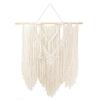
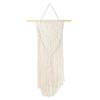
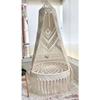
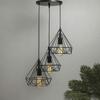
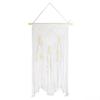
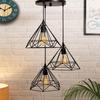
A large drop macrame chandelier woven in Indonesia from cotton rope. It brings the kind of sculptural warmth to a room that no factory fitting can replicate, knotted textile catching and softening light, casting layered shadow across walls and ceiling, turning a plain space into something quieter and more considered.
What the piece does to a room
The generous drop gives it real presence, drawing the eye upward and anchoring the space beneath it.
Cotton rope diffuses light rather than directing it, so the glow around it is soft and uneven in the best way, with shadow moving through the knots as the light shifts.
The black cord reads as a graphic element in daylight, almost sculptural, and shifts to something moodier and more atmospheric once the bulb is on.
The fringe and knotted tiers move slightly in a draught, giving the piece a quiet life of its own.
Cotton, knotted in Indonesia
Each chandelier is woven in Indonesia using cotton rope. The knotting means no two pieces come out exactly alike, the tension varies slightly, the fringe falls at its own angle, and the overall form carries the small irregularities that distinguish hand-work from machine production. Cotton is an honest material for this: it holds a knot firmly, and develops a subtle softness over time near a bulb's warmth.
Installation and what you need to know
The chandelier requires a ceiling rose or pendant fitting, the light fitting is not included, and you will need to source one separately. Use only LED, low-energy, or energy-efficient bulbs, which stay cool; a bulb that runs hot is not suitable for a textile shade. If you are not confident with electrical installation, a qualified electrician is the right call. The chandelier weighs 1,200 g, so the ceiling fixing needs to be secure, into a joist or with an appropriate anchor for your ceiling type.
Placement and styling
It works best hung where the full drop can be appreciated: above a dining table, centred in a bedroom, or in a…
region of manufacture: Indonesia


 Товар из Великобритании


 Возврат по недоставке