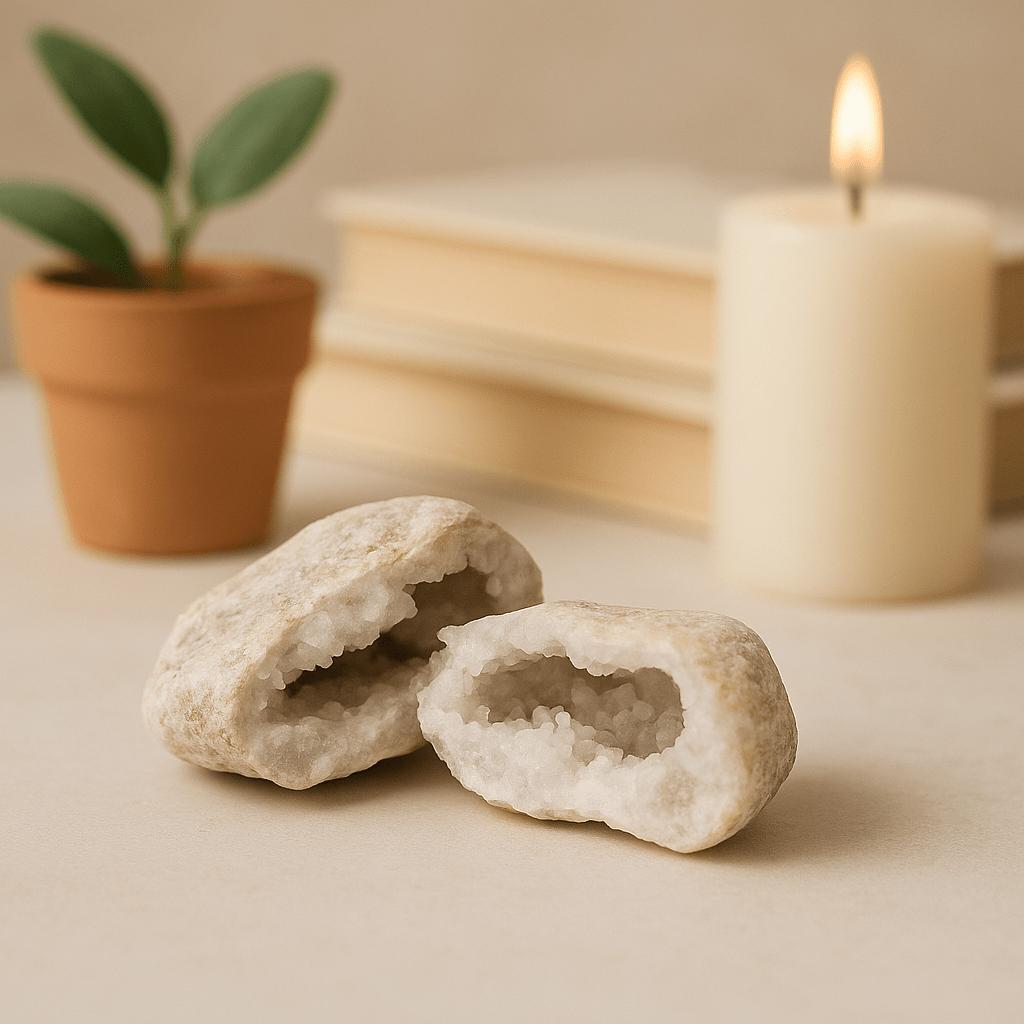
A small geode brings the theatre of the Earth into your hand: a rough outer stone opened to reveal a bright, crystalline interior. This Moroccan calcite geode has the quiet drama of a natural sculpture, with pale mineral surfaces and sparkling pockets that catch the light as you turn it.
What you are looking at
A split-open geode, showing the contrast between a plain outer shell and the crystal-lined space within.
Calcite gives the piece its pale, luminous character, with a surface that feels more cave-like than polished.
The hollow interior creates depth, so the eye keeps moving across ridges, openings and little points of light.
At this scale, it feels intimate rather than showy, suited to a shelf, desk or bedside corner.
Calcite is traditionally associated with clarity, learning and mental focus, often kept as a contemplative stone rather than a purely decorative object.
Calcite and selenite from Morocco
This piece is from Morocco and belongs to the Calcite Geodes range. Geodes form when mineral-rich water moves through hollow spaces in rock, slowly leaving crystals behind on the inside. That inward growth is what gives a split geode its sense of discovery, as if the most interesting part of the stone was kept quietly hidden until opened.
Where it sits well
Place it where light can reach the crystal face: a windowsill away from damp, a writing desk, a small altar space or a shelf of natural objects. It pairs beautifully with wood, linen, ceramics and other mineral pieces, adding texture without needing a large display area.
A note on natural variation
Each geode is naturally different. The size, shape and colour of the piece you receive may vary slightly from the one shown, and the crystal pattern will be its own. That variation is part of the appeal: no two openings reveal exactly the same landscape inside.
Keeping it dry
This geode contains selenite, a soft form of gypsum that dislikes water and humidity. Do not wash, soak or keep it in …
region of manufacture: Morocco


 Товар из Великобритании


 Возврат по недоставке