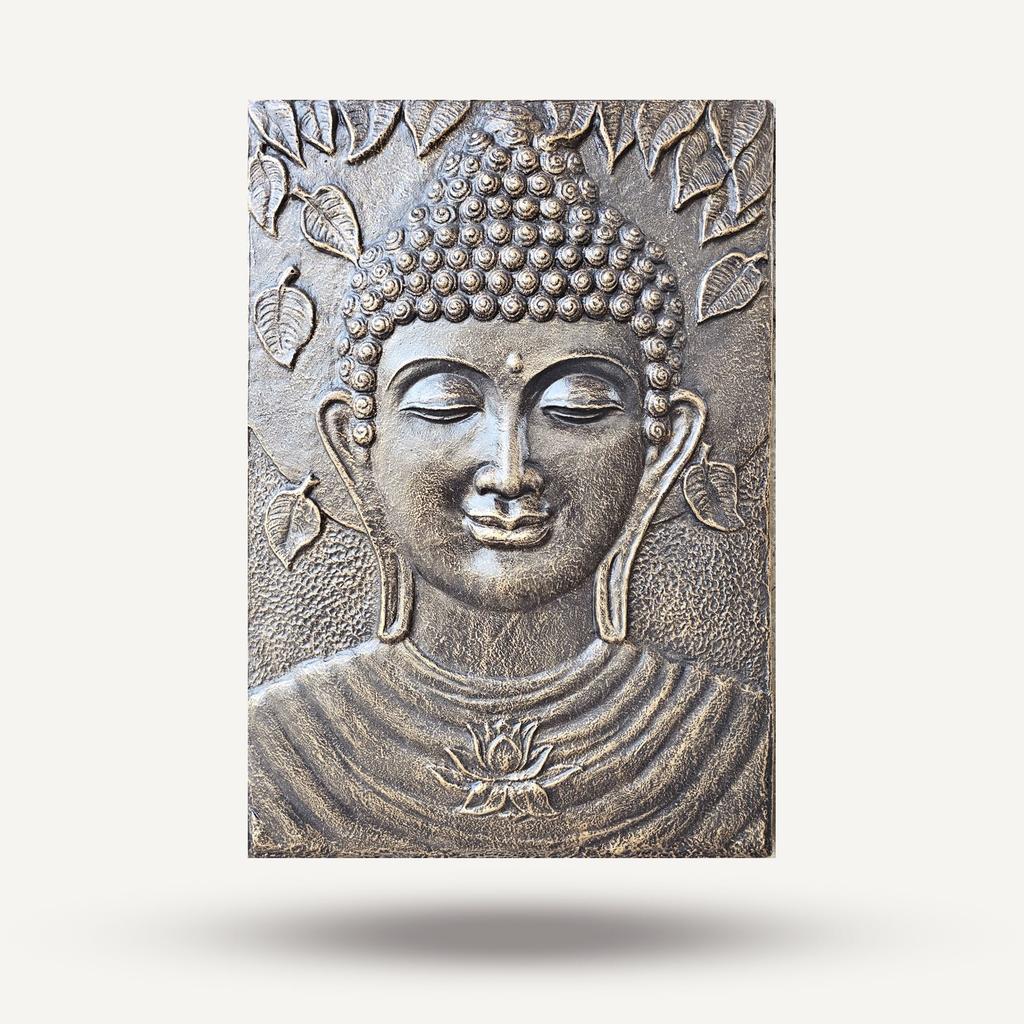
A large-format wall relief in antique gold, 70 cm wide and 100 cm tall, cast from fibre cement and finished to read like aged stone. The Buddha motif sits in low relief against a leaf-textured ground, the whole surface washed in a warm, burnished gold that deepens in shadow and catches the light at the edges. At 14 kg, it has the quiet authority of something architectural rather than decorative.
What it brings to a wall
The antique gold finish shifts with the light, cooler in the morning, warmer under evening lamps, so the piece reads differently through the day.
The leaf-pattern ground gives the surface movement without busyness, framing the central figure with organic texture.
At a metre tall, it fills a wall the way a large canvas does, but with the added dimension of shadow falling across the relief.
The fibre cement construction means the finish is consistent and durable, with none of the fragility of plaster or the flatness of a print.
The weight and depth make it feel permanent, closer to architectural detail than to a hung picture.
Fibre cement, made in Indonesia
Fibre cement is a composite of cement, sand, and cellulose fibres that produces a surface holding fine detail without the brittleness of pure plaster. It is heavier and more durable than resin, and takes a painted or antiqued finish well. This piece is made in Indonesia, where the craft of decorative cement casting has a long tradition in both temple and domestic architecture.
The figure and its tradition
The Buddha depicted here sits within a composition of stylised leaves, a motif that appears across Buddhist and Hindu temple carving throughout South and South-East Asia, where the leaf or lotus form traditionally represents growth, renewal, and the natural world as a setting for contemplation. In Buddhist iconography, the seated figure in repose is one of the oldest and most widely recognised forms, associated across many traditions with stillness and the practice of meditation…
region of manufacture: Indonesia



 Товар из Великобритании


 Возврат по недоставке