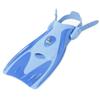
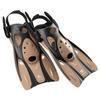
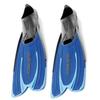
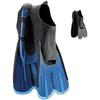
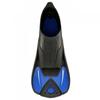
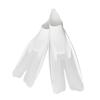
These lightweight, compact snorkeling fins were designed for Japanese people by Tabata, a diving equipment manufacturer (TUSA) in Asakusa, Tokyo.
The small size weighs just about the same as a block of tofu! These fins are the lightest and most compact, making them a valuable addition to any travel enthusiast.
What do you think of fins? Many people associate them with helping you swim faster and with ease.
Surprisingly, snorkeling fins aren't just for "moving forward"!
Of course, wearing fins increases your propulsion, allowing you to move faster and more comfortably.
However, snorkeling is more about "floating" than "moving forward." And that's what fins are used for.
Why do we need fins to "float"? Because without fins, your feet will sink, resulting in what's known as "treading water."
This drains your stamina more than you might think and can pose risks, such as leg cramps.
Using fins naturally keeps your feet afloat, allowing you to relax, enjoy snorkeling, and ensure safety!
Of course, simply floating would take away from the fun of wearing fins.
That's why REEFTOURER fins are designed to provide optimal propulsion for snorkeling while remaining compact.
By using materials with different hardness levels, the blades (the parts of the fins that receive water) are flexible, providing just the right amount of propulsion.
This allows for solid propulsion despite the lightweight and compact design.
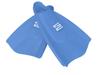
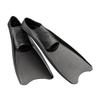
If you want more propulsion or want to try skin diving, we recommend tusasports rubber fins.
Also made by Tabata, these fins are large and heavy, but provide solid propulsion.
REEFTOURER compact fins also have a strap that can be easily adjusted to fit your size.
To adjust the straps, simply press the buckle lever with your fingertips and pull the inner strap to lengthen them, then slip your feet in and pull the outer strap! This is all it takes to ensure a snug fit that won't slip off.
Enjoy a more comfortable snorkeling experience with easy-to-wear REEFTOURER fins.
[Why fins are recommended for snorkeling] Some people may think, "I can swim well enough, so I don't need fins when snorkeling." It's certainly possible to enjoy snorkeling without fins. However, fins make snorkeling more comfortable and safe! There are three benefits to wearing fins while snorkeling. The first is that they provide greater propulsion. This may be easy to imagine. Since fins are essentially "flippers," swimming with fins allows you to swim much faster and more easily than barefoot. The second benefit is that they add buoyancy to your feet. Some of you may be wondering, "Buoyancy? Fins?" Think about it for a moment. When you enter the ocean wearing a swim ring, what do your feet do? They're down. This is what's known as treading water. It's recommended to wear a snorkeling vest when snorkeling, which allows your upper body to stay afloat, just like wearing a swim ring. However, your feet tend to sink, just like the swim ring. This means that if you spot a beautiful fish or a beautiful landscape, you'll end up in a position similar to treading water, which requires a lot of energy. Fins naturally lift your feet, making it easier to float even when stationary, making snorkeling more comfortable. The third benefit is improved visibility. Using fins allows you to generate more propulsion with less kicking, reducing lower body movement while swimming and stabilizing your visibility. This reduces shaking, allowing you to take better photos!
[Lightweight and Compact Fins Recommended for Snorkeling] REEFTOURER's lightweight and compact fins are extremely convenient for travel and portability, easily storing them in a suitcase or backpack. These fins are compact and easy to carry around when moving around the beach, significantly reducing the burden of carrying fins that many people experience when enjoying snorkeling. Some may be concerned about whether compact fins provide sufficient propulsion, but snorkeling is a sport where you float leisurely and observe the underwater world. Unlike diving, a large propulsive force is not necessary. The key is to add buoyancy and move slowly with minimal kicking. In fact, compact fins with their maneuverability are particularly useful around rocky areas. Furthermore, while barefoot fins require repeated flapping movements, which can easily escape fish, wearing fins and swimming slowly with minimal kicking can prevent the fish you want to see from escaping. REEFTOURER fins are designed to provide optimal propulsion for snorkeling, allowing for maneuverability and ease of swimming, making them truly snorkeling-specific fins.
[Compact Fins vs. Long Fins] There's a reason we recommend compact fins for snorkeling. There are two types of fins: compact fins and long fins. The main difference between the two is propulsion. Long fins offer greater propulsion due to their wider range of motion. Long fins are recommended for deep diving and those accustomed to swimming who want to dive deeper without using a fin. Compact fins, on the other hand, are recommended for snorkelers, beachgoers, and beginners. While long fins provide greater propulsion, they also put a strain on leg muscles, requiring more physical effort. They require more practice, as they don't splash water well with normal foot movements. Compact fins, on the other hand, while not as powerful as long fins, put less strain on leg muscles, allowing you to enjoy underwater observations for longer periods of time. Furthermore, because the load on your feet is not much different from swimming barefoot, you can move more intuitively and smoothly. Compact fins also have the advantage of being less likely to hit rocks or other obstacles than long fins. Long fins are quite long, so you might accidentally reach a rocky area you thought was safe and accidentally bump into it, or accidentally injure coral reefs or other marine life. Compact fins, however, don't change your overall length, so moving instinctively is less likely to result in the same problem. Therefore, for first-time snorkelers, those less confident in their physical strength, and children, using compact fins can make snorkeling more comfortable and enjoyable.
[Strap fins that can be worn with marine shoes] REEFTOURER's compact snorkeling fins can be worn with bare feet, fin socks, or marine shoes (marine boots). We especially recommend wearing the fins with marine shoes (marine boots). The sand can get very hot in the summer at the beach. Also, the water's edge can be pebbly, and you might start snorkeling from a rocky area, so it's a good idea to have some footwear when you're near the water. While you could wear sandals and change into them at the beach, that raises the issue of what to do with the sandals. However, walking to the water's edge while wearing fins can be quite difficult. This problem is instantly solved by simply wearing your water shoes and then putting on your fins. Your feet are protected and safe.
[Easy-to-Adjust Straps] A properly fitting fin makes swimming easier and snorkeling more enjoyable. REEFTOURER strap fins can be easily adjusted to fit your feet perfectly with a simple push of the buckle and a pull of the strap, so anyone can enjoy a comfortable swim. Plus, each size is adjustable by 5cm, so even growing children can use them without having to buy new fins frequently. ■Suitable foot sizes for each size (S/M/L) [S size] Bare feet/socks: 18-22cm, marine shoes/marine boots: 16-20cm [M size] Bare feet/socks: 22-26cm, marine shoes/marine boots: 20-24cm [L size] Bare feet/socks: 26-30cm, marine shoes/marine boots: 24-28cm
![[Amazon.co.jp Exclusive] REEF TOURER Lightweight and Compact Snorkeling Fins with Adjustable Straps, Fits Over Water Shoes, Blue, Small (RF0106P)](https://img-edg.joomcdn.net/d5a56405116f1538176b5de14365ae605317f448_original.jpeg)
![[Amazon.co.jp Exclusive] REEF TOURER Lightweight and Compact Snorkeling Fins with Adjustable Straps, Fits Over Water Shoes, Blue, Small (RF0106P)](https://img-edg.joomcdn.net/1baabed2a8232fbacd84a5e430d9a1fa47741690_original.jpeg)
![[Amazon.co.jp Exclusive] REEF TOURER Lightweight and Compact Snorkeling Fins with Adjustable Straps, Fits Over Water Shoes, Blue, Small (RF0106P)](https://img-edg.joomcdn.net/7a5c6786de1bc191dc4ff1d4ec0c5cde163a316b_original.jpeg)
![[Amazon.co.jp Exclusive] REEF TOURER Lightweight and Compact Snorkeling Fins with Adjustable Straps, Fits Over Water Shoes, Blue, Small (RF0106P)](https://img-edg.joomcdn.net/6331f1ab473c8fd5641f469c0c36398001928713_original.jpeg)
![[Amazon.co.jp Exclusive] REEF TOURER Lightweight and Compact Snorkeling Fins with Adjustable Straps, Fits Over Water Shoes, Blue, Small (RF0106P)](https://img-edg.joomcdn.net/e5dd32711498f1afc09499792aa53aaca4b24195_original.jpeg)
![[Amazon.co.jp Exclusive] REEF TOURER Lightweight and Compact Snorkeling Fins with Adjustable Straps, Fits Over Water Shoes, Blue, Small (RF0106P)](https://img-edg.joomcdn.net/0594610089d5ea6976bb28cd13601b6b0e36957b_original.jpeg)
![[Amazon.co.jp Exclusive] REEF TOURER Lightweight and Compact Snorkeling Fins with Adjustable Straps, Fits Over Water Shoes, Blue, Small (RF0106P)](https://img-edg.joomcdn.net/c3ae40af09a31628e41c10276cf473a7fb32d7d2_original.jpeg)
![[Amazon.co.jp Exclusive] REEF TOURER Lightweight and Compact Snorkeling Fins with Adjustable Straps, Fits Over Water Shoes, Blue, Small (RF0106P)](https://img-edg.joomcdn.net/ec87d70ad140371159644e02260565bf036636b8_original.jpeg)





![[Amazon.co.jp Exclusive] REEF TOURER Lightweight and Compact Snorkeling Fins with Adjustable Straps, Fits Over Water Shoes, Black, Large (RF0106P)](https://img-edg.joomcdn.net/837d0152443bb46fc821db7a1c9ae4dab0877e2b_100_100.jpeg)